
Our Work
Photographs of jobs we have finished across Nottingham and the surrounding towns, with the materials, colours and finishes used on each one. Everything here is our own work, photographed on site.
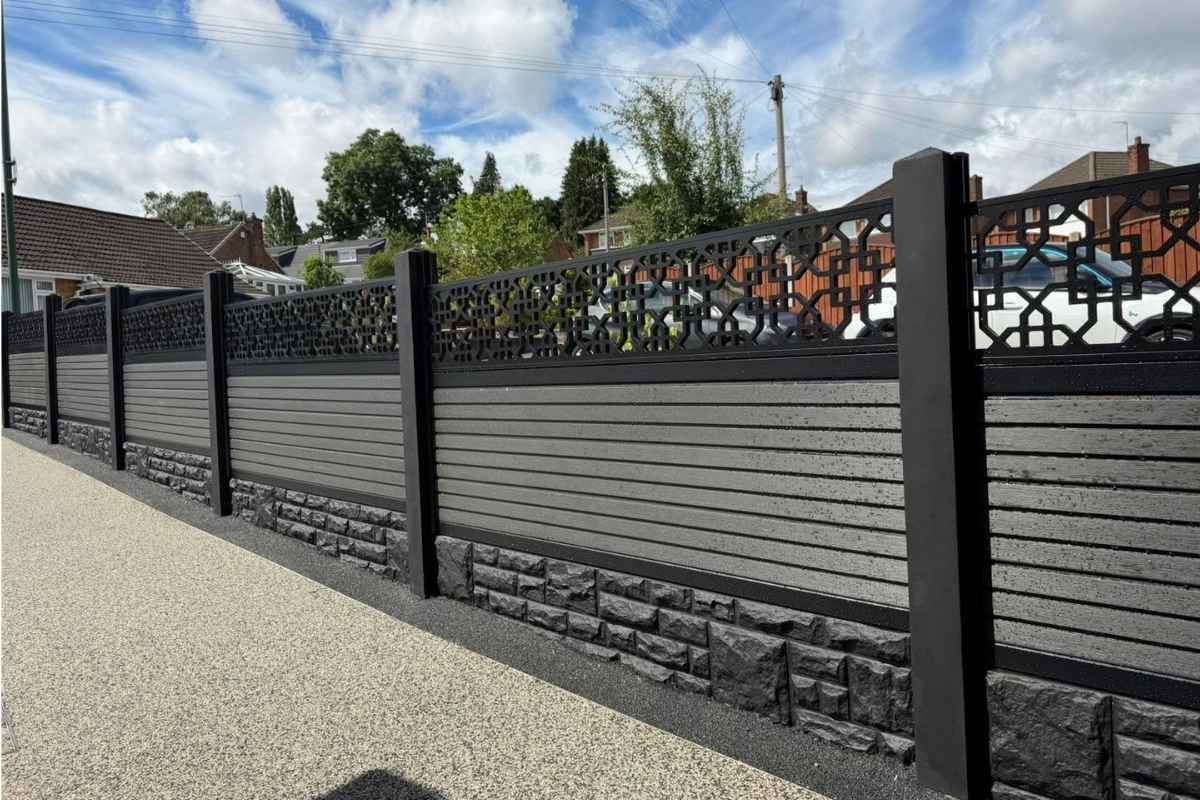
Composite Fencing
Composite is the most requested upgrade we fit. No treating, no silvering, and it holds its colour well past ten years. Every run below is on concrete posts with gravel boards — the part underneath is what decides how long the part you see lasts.
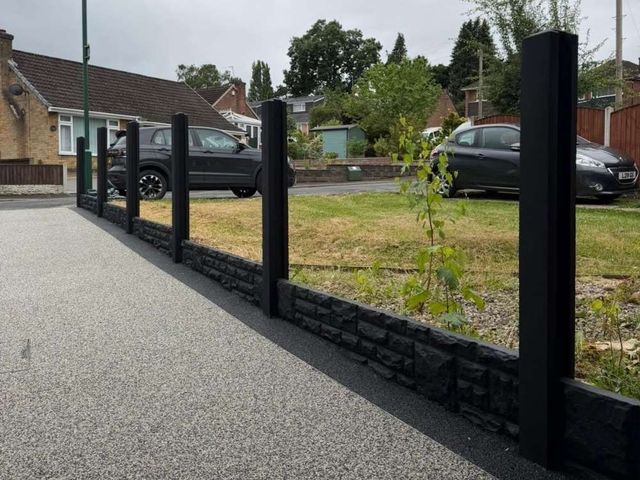
Posts and boards in first
Black-painted concrete posts and rock-faced gravel boards set out before a single panel goes in. Getting this stage right is what the finished run depends on.
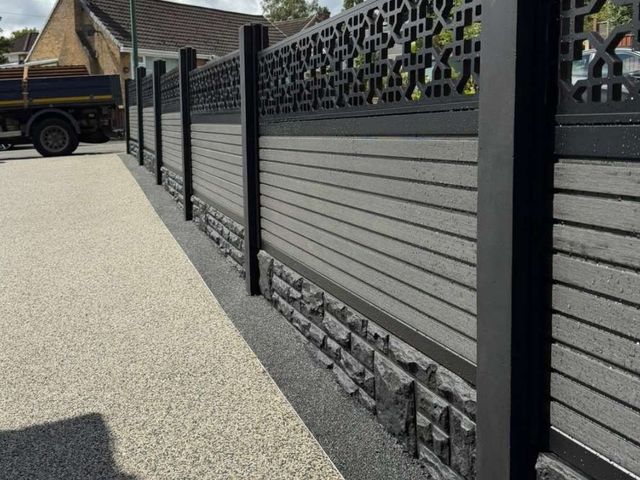
The finished run
Grey composite boards in a black frame with cathedral design screening above, alongside a resin driveway.
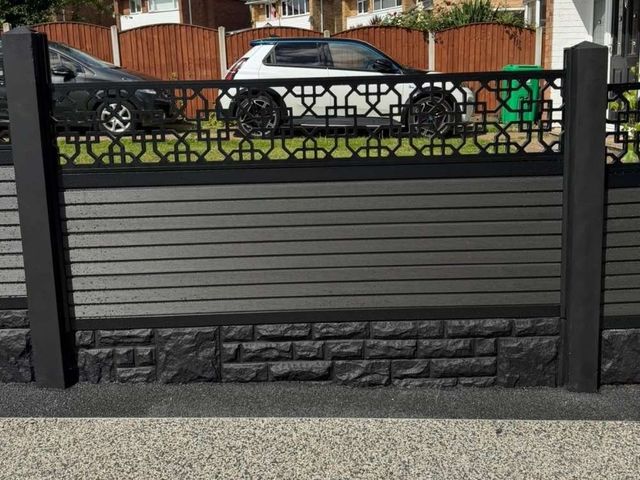
Close up of the detail
The board profile, the black frame and the rock-faced gravel board at the base. Composite fencing in Bulwell, using concrete posts and rock-faced gravel boards with cathedral design composite screening.
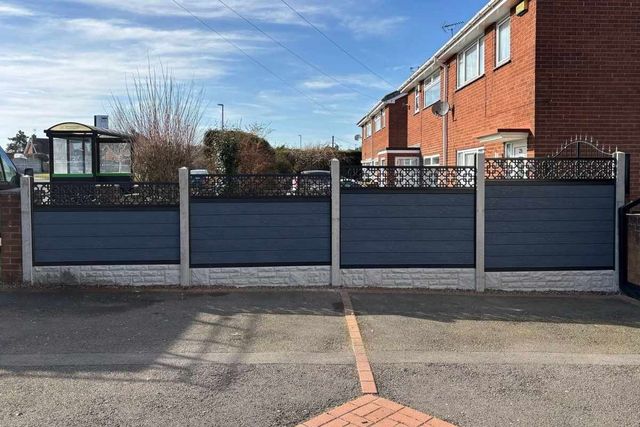
Silver grey with decorative toppers
A front boundary in Mansfield. The lighter silver grey reads very differently from anthracite in daylight.
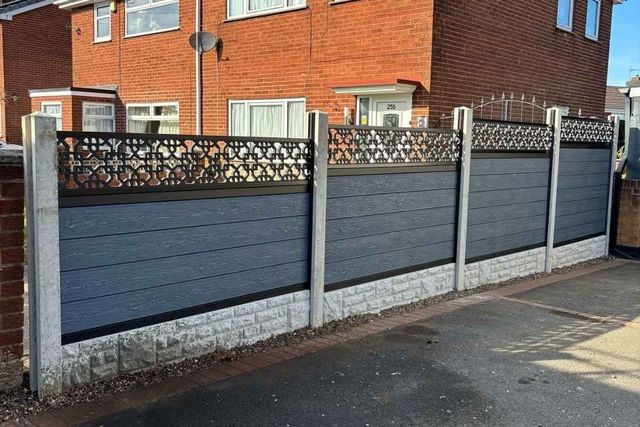
Front boundary, Mansfield
Same job from the road. Front boundaries are generally limited to 1 metre where they front a pavement.
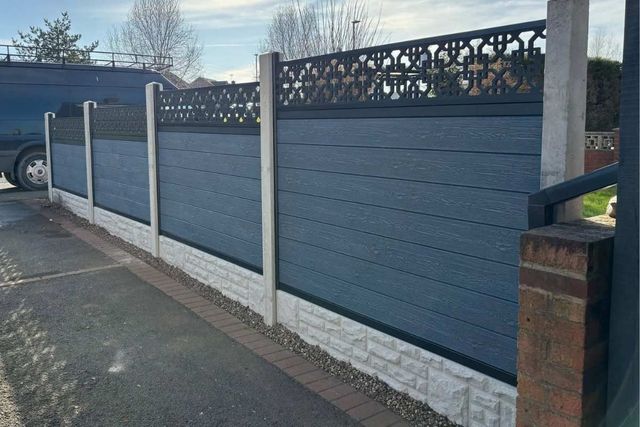
Fitted into concrete posts
Composite panels drop into standard concrete posts, so an existing post line can often be reused.
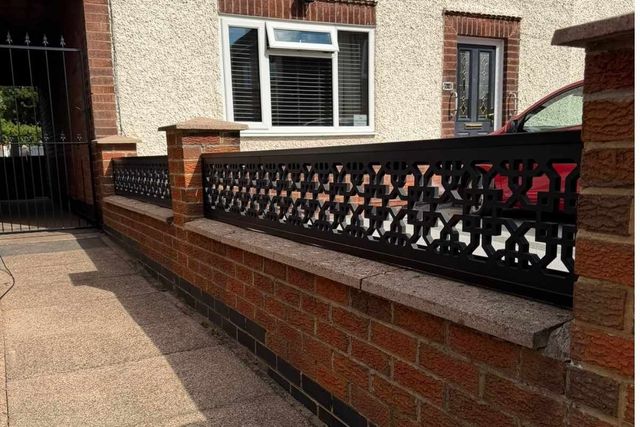
Wall-top screening, Long Eaton
Cathedral design composite screening fixed along an existing brick wall — height and privacy without rebuilding the wall.
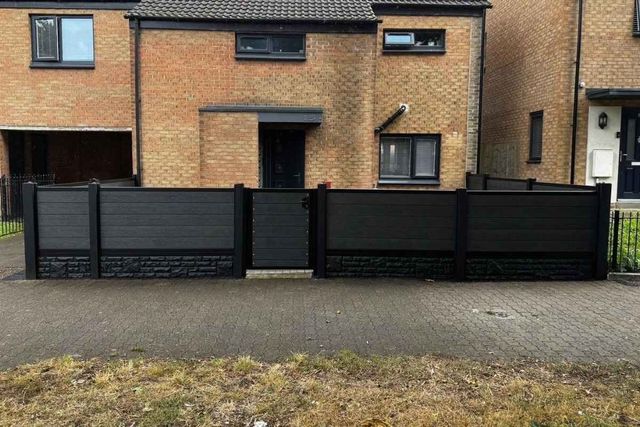
Front garden fencing and gate, Hucknall
A low front boundary with matching gate. Ordering the gate with the panels is what keeps the colour consistent.
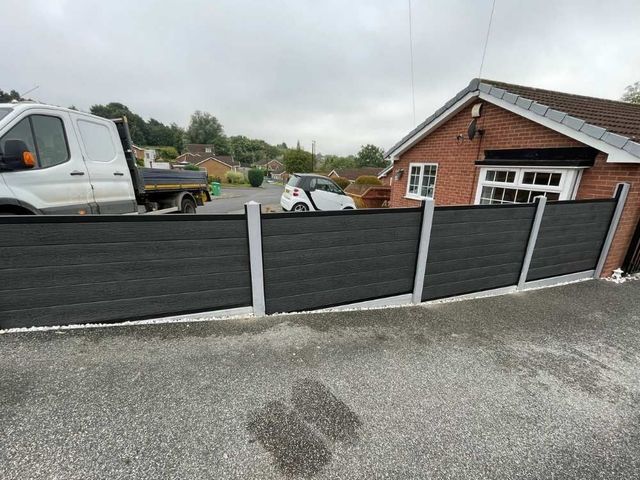
Anthracite in a black frame
The two-tone effect of grey boards in a black frame, fitted into concrete posts alongside a driveway.
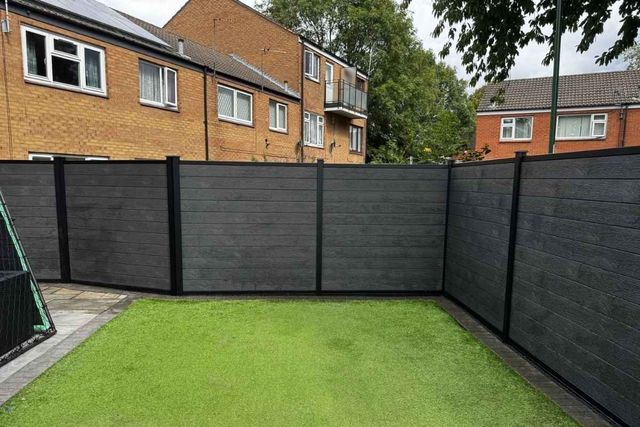
Rear garden boundary
A full rear boundary in anthracite grey. On a long run, never having to treat it is the whole argument for composite.
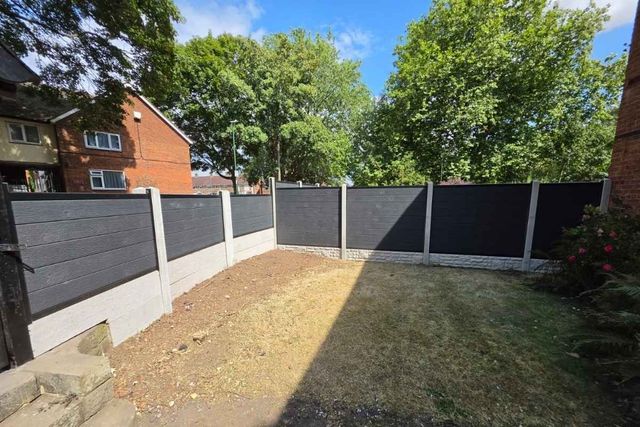
Front garden, Sutton in Ashfield
Composite on concrete posts along a front garden, with the ground still to be made good.
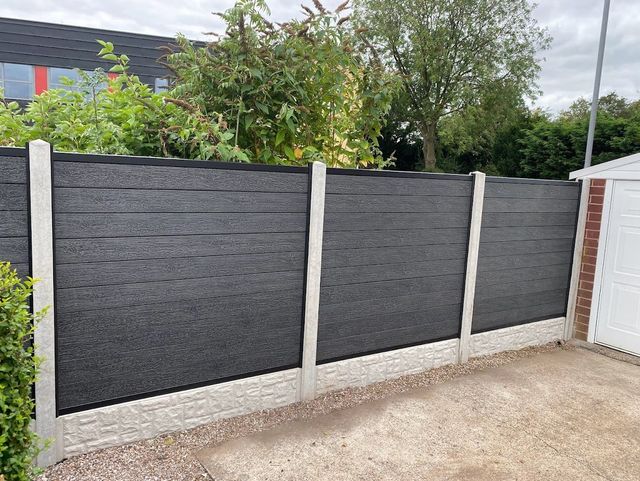
Chilwell
Panels between concrete posts with gravel boards — the specification we fit most often.
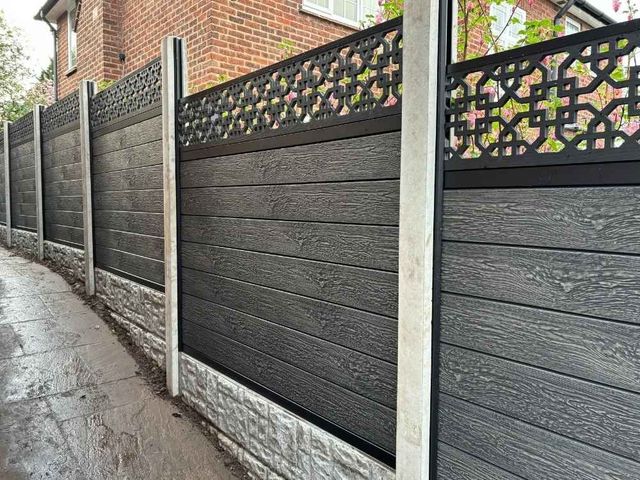
Alleyway boundary
Cathedral screening above a solid run along an alleyway. Concrete posts matter more where you do not control the far side.
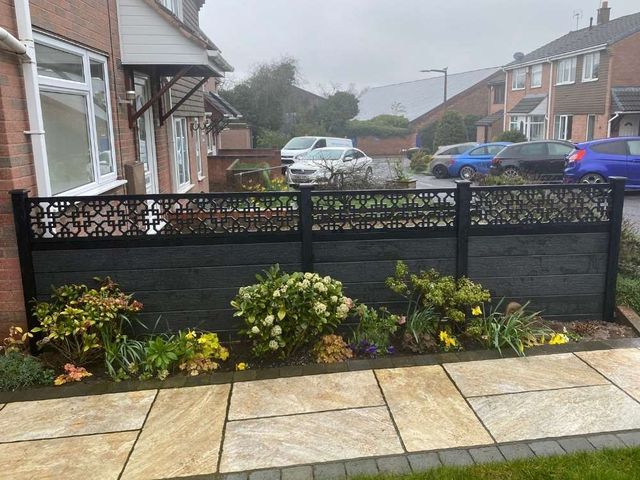
Behind a planted border
Composite behind established planting. Nothing needs brushing or treating behind a border you cannot reach.
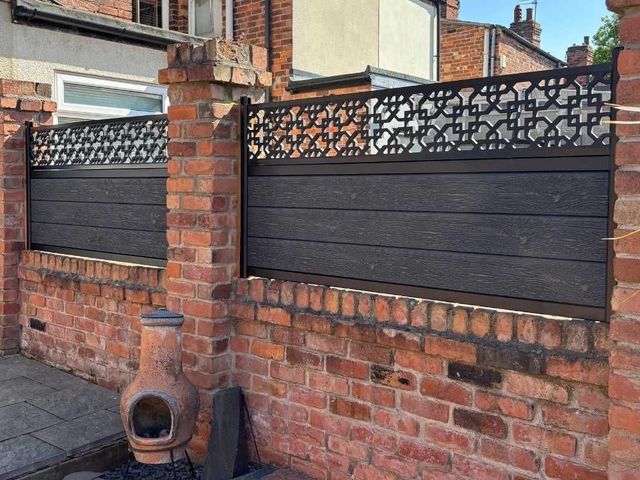
Mounted on an old brick wall
Fitted above sound Victorian brickwork rather than replacing it — far cheaper, and the wall outlasts any fence.
Silver grey with cathedral screen
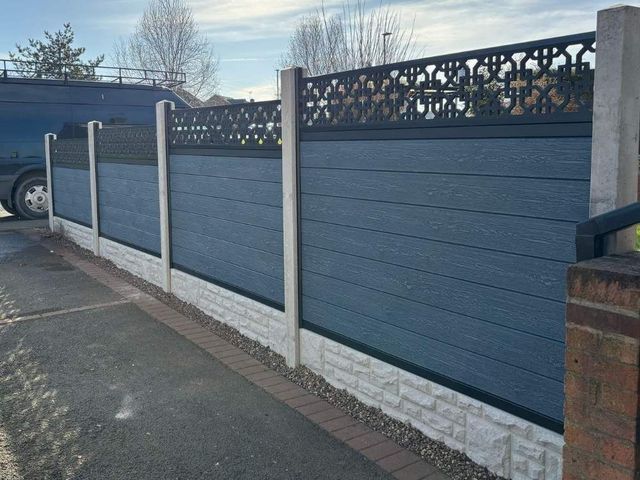
The same screen design in silver grey. Worth seeing a colour along a full run rather than on a sample board.
Palm leaf topper
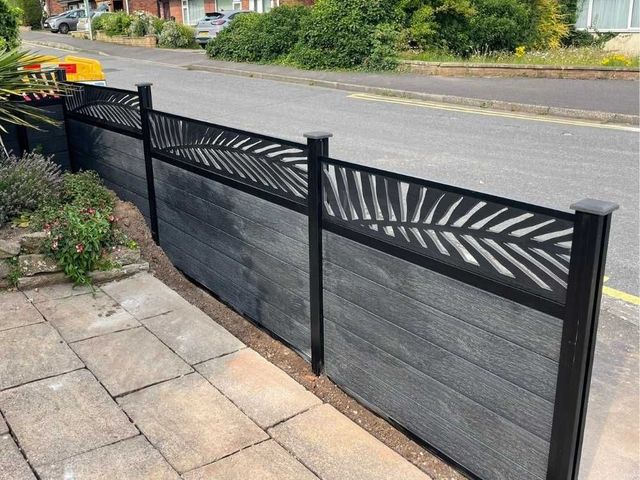
A different screen profile on the same board. The topper is where most of the character comes from.
Horizontal bar screen
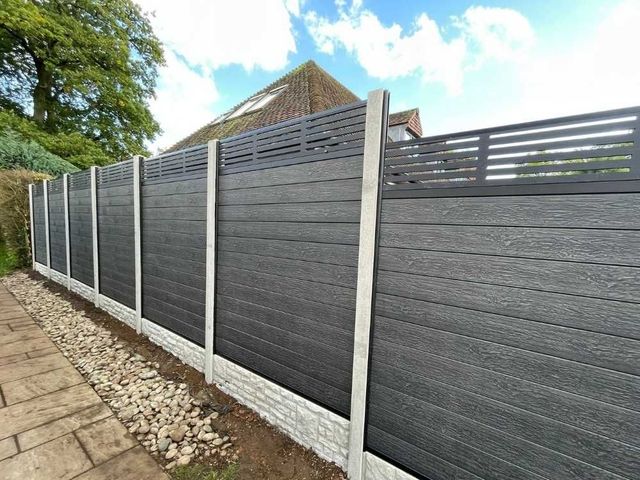
A plainer bar screen for a more contemporary finish, on concrete posts and rock-faced gravel boards.
Between brick pillars
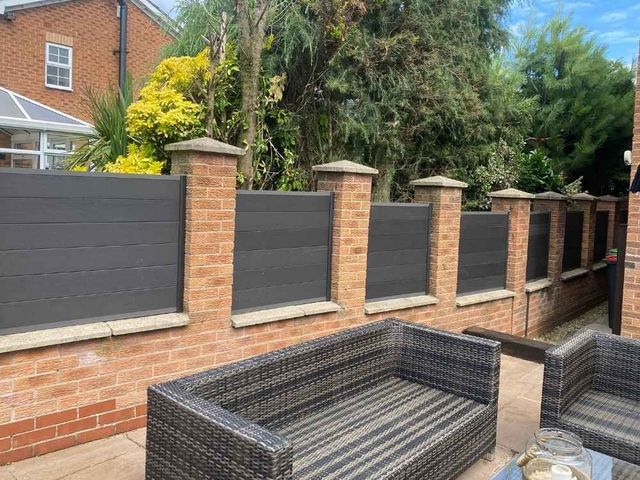
Panels made to fit each opening between existing pillars, which is where made-to-measure earns its money.
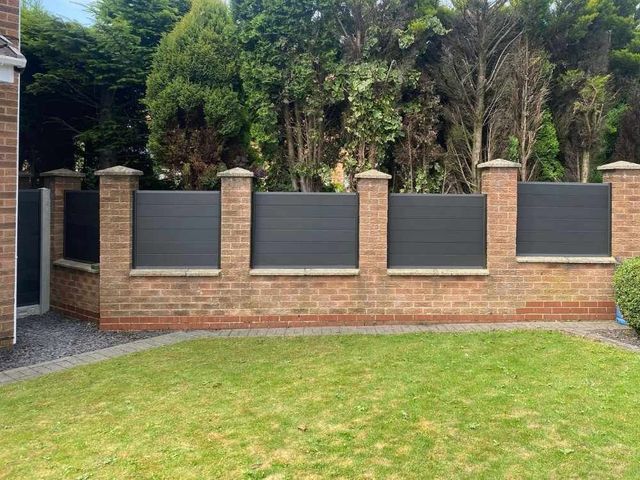
The same job from the lawn
Every bay is a slightly different width. Stock panels do not fit an opening like this; made-to-measure ones do.
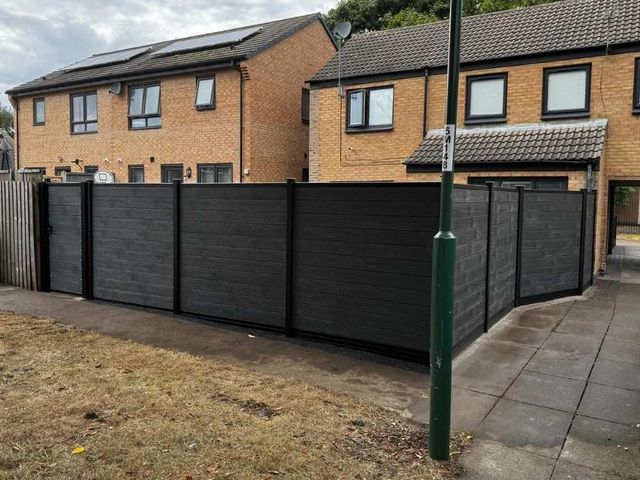
With a matching gate
Fence and gate ordered together so the colour and board profile match — a gate made later rarely does.
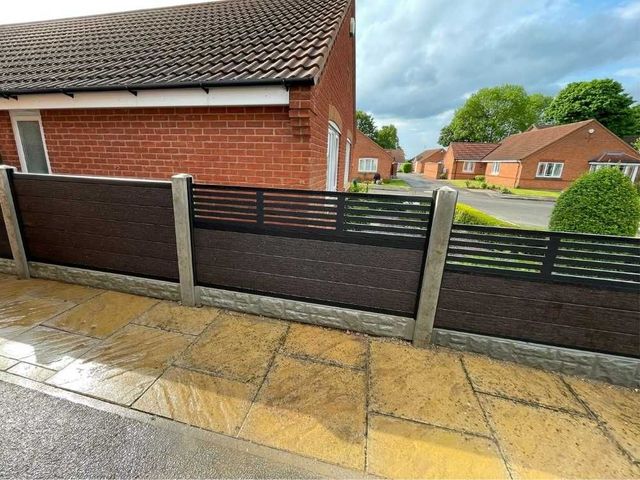
Walnut with a slatted screen
Not everything has to be grey. Walnut boards with a slatted composite screen above, on concrete posts and rock-faced gravel boards. Composite comes in brown, cream and green as well as the greys — worth asking to see a colour along a real run before deciding.
Composite Driveway Gates
Every gate here was made to the opening rather than cut down from a stock size — a driveway entrance is almost never square, and it shows immediately when a gate is forced to fit one. Composite boards in an aluminium frame, hung on adjustable hinges and finished to match the fencing where there is any.
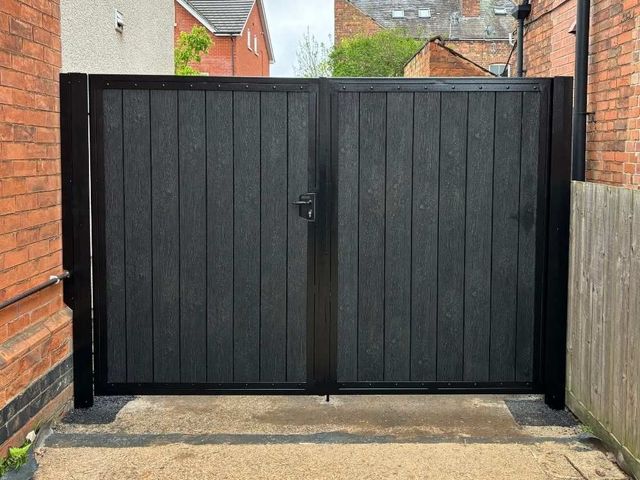
Flat top double gates
Solid vertical composite boards in a black aluminium frame, made to fill the opening between two walls. Nothing to treat and nothing to warp. The full range, and how they are measured, is on the composite driveway gates page.
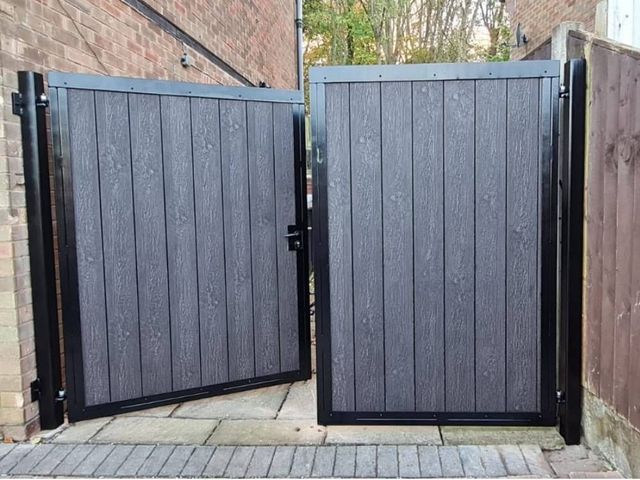
Anthracite grey, part open
Hung on adjustable hinges so the leaves can be trued up on site — an opening between two buildings is rarely square.
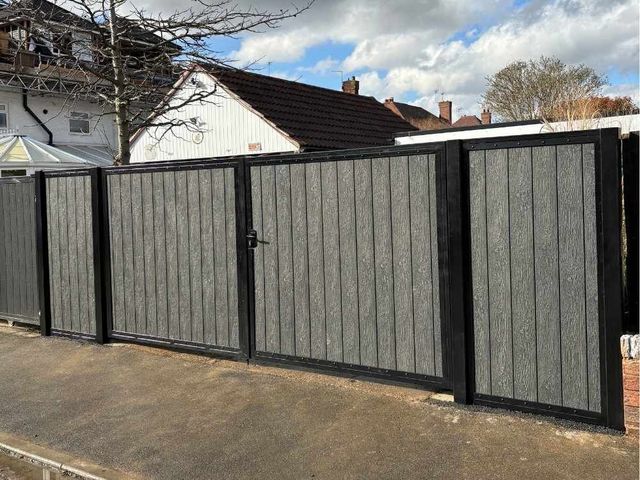
Gates with matching fencing
Gates and flanking panels ordered together so the board profile and colour match. Made separately they rarely do.
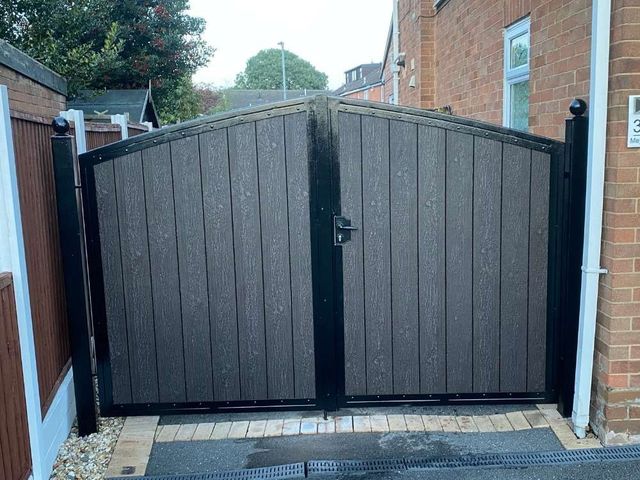
Arched top with ball finials
An arched head lifts the centre of the opening. The ball finials are a small detail that changes how the whole entrance reads.
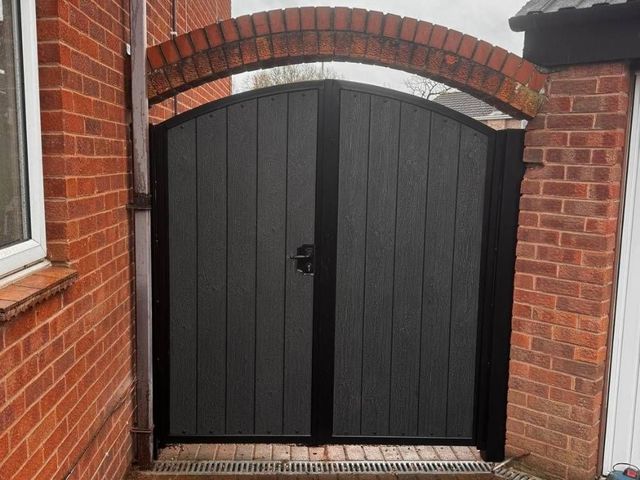
Arched to fit an arch, Arnold
Made to follow the brick arch above it. A stock gate cut down would have left a gap the shape of the arch — this one was built to the curve.
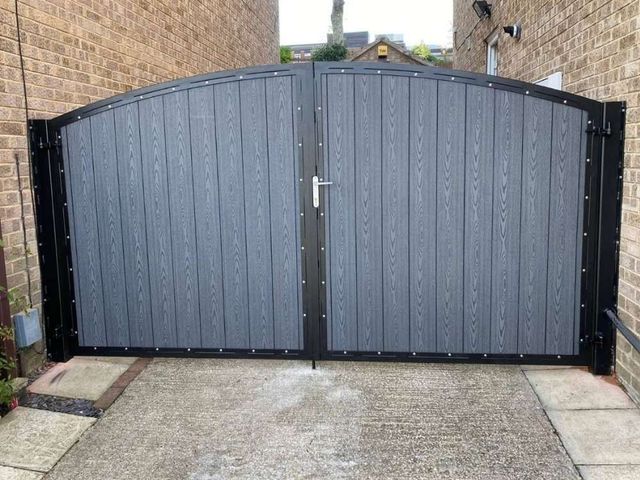
Arched, grey woodgrain
A deeper woodgrain emboss on the same board. Composite holds this texture without the splitting timber develops.
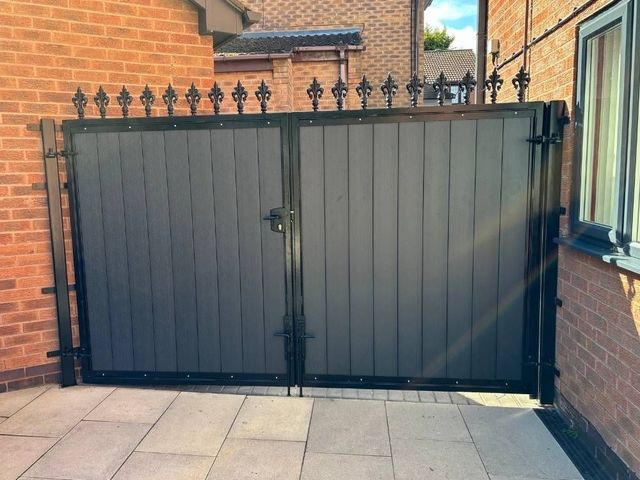
Fleur de lis on a flat head
Cast finials set along a straight head. Metal detail on a composite gate gives the look of wrought iron with none of the upkeep.
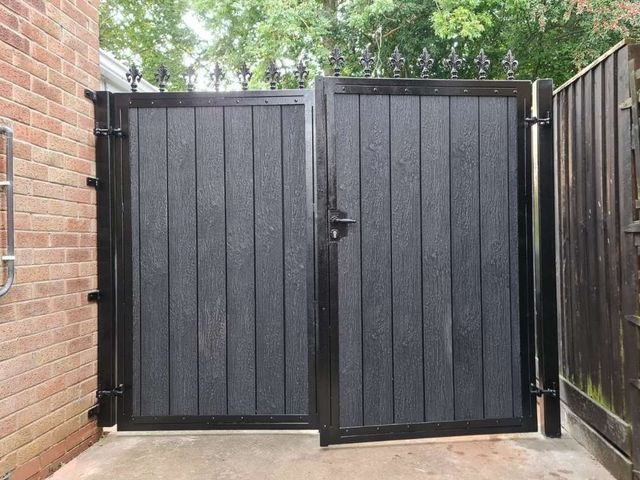
The same detail in a passage
Fleur de lis on a narrower opening between house and boundary. The finials sit above the frame, so they add height without adding weight to the leaf.
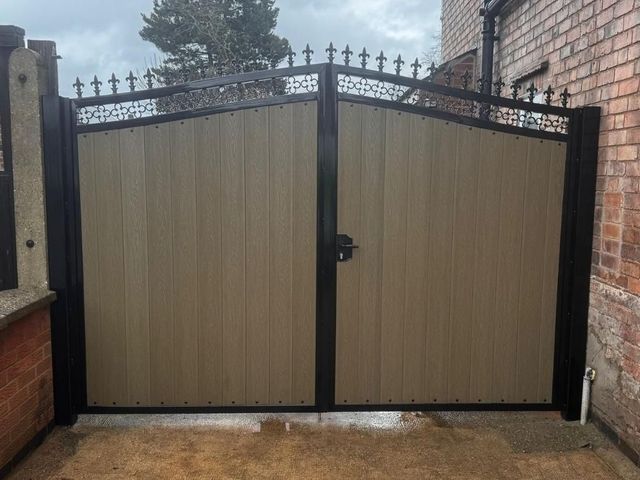
Fleur de lis frieze, Long Eaton
A lighter natural board with an ornamental frieze and finials above — the fullest version of the three, and the one that changes the entrance most.
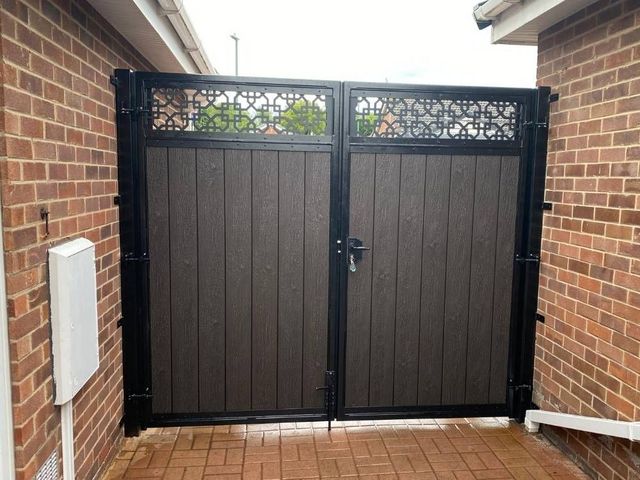
Walnut with cathedral top
The cathedral screen used on the fencing, carried onto the gate. It lets light through the head of the opening without losing privacy at eye level.
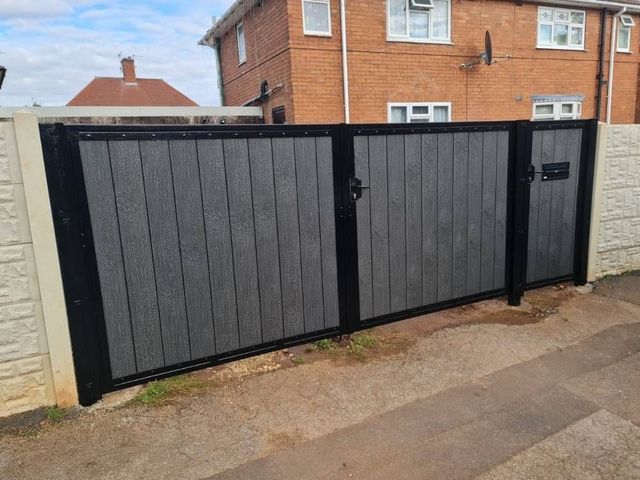
A full entrance with postbox
Double driveway gates with a matching pedestrian gate alongside, and a postbox built into the leaf so the postman never needs the gate opened.
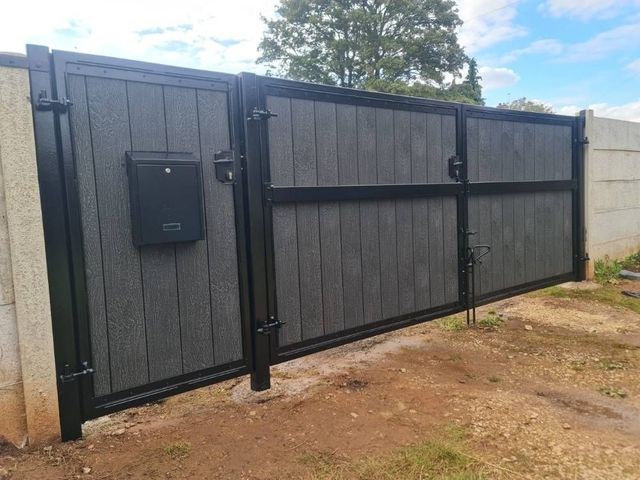
The same entrance from inside
From the drive. The postbox is emptied from this side, and the frames, drop bolts and hinges are all sized for the weight of a composite leaf.
Composite Pedestrian & Side Gates
Side and garden gates get used every day, which is why the frame and hinges matter more than the boards do. Every one here is made to its opening — passages between houses are rarely square, rarely plumb, and almost never a standard width.
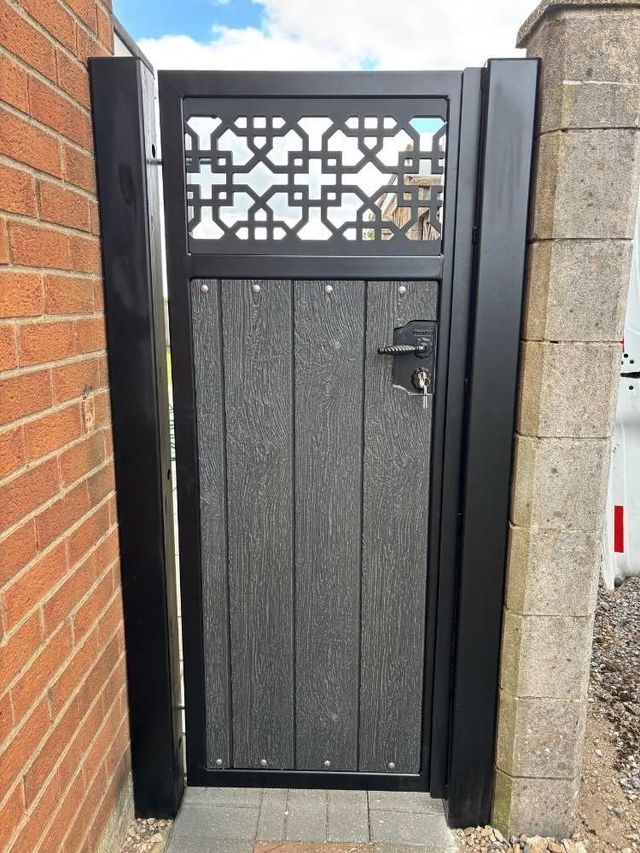
Cathedral screen top
A solid leaf with a cathedral screen above it. Light and a sight line at the top, privacy where it matters. Board, frame colour and screen options are set out on the composite gates page.
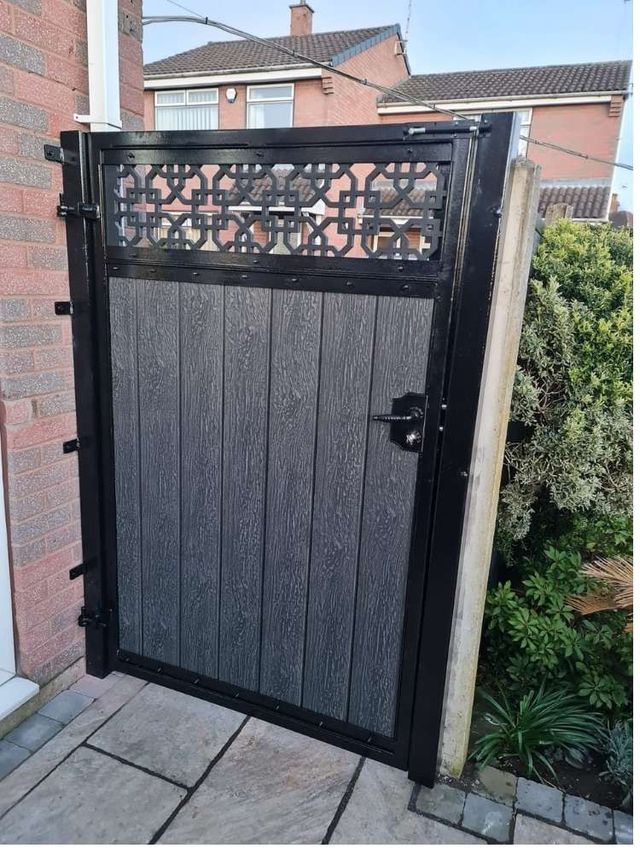
The same, on a wider opening
A wider single leaf. Past a certain width a gate needs heavier hinges and a deeper frame, which is decided at the survey rather than after.
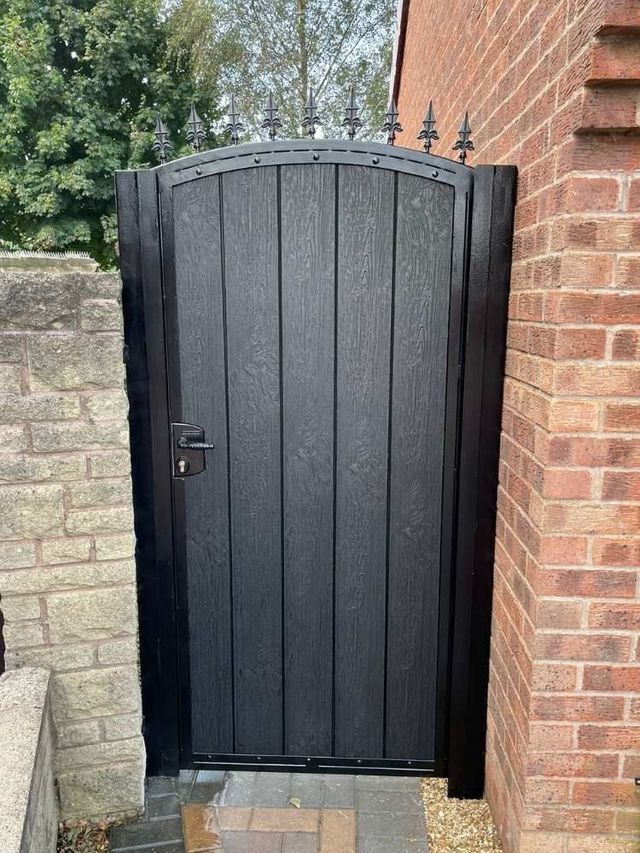
Arched with fleur de lis
An arched head with cast finials above. The arch is cut into the frame, not the boards, so the leaf stays square and true.
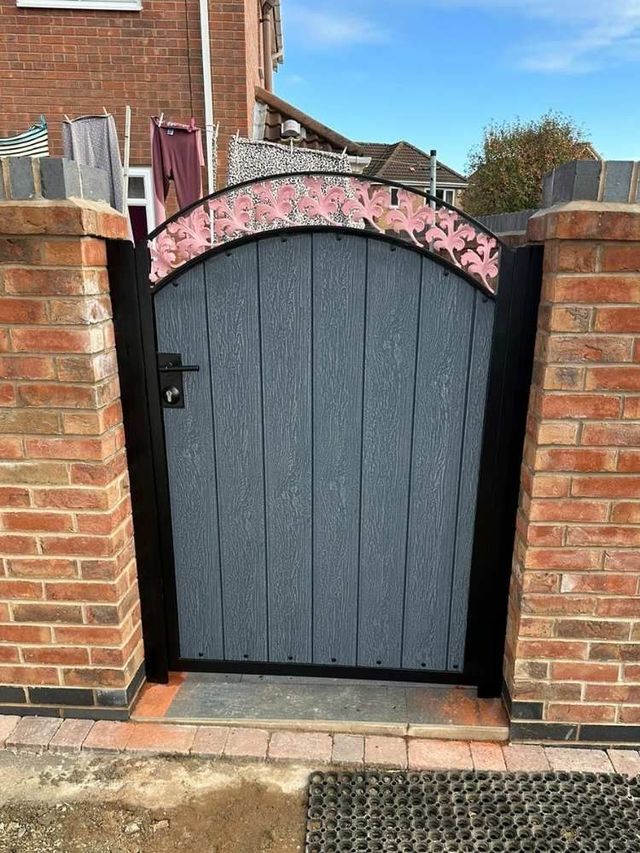
Pink floral detail
Powder coating is not limited to black. A decorative panel finished to a colour the customer chose, on a standard grey leaf.
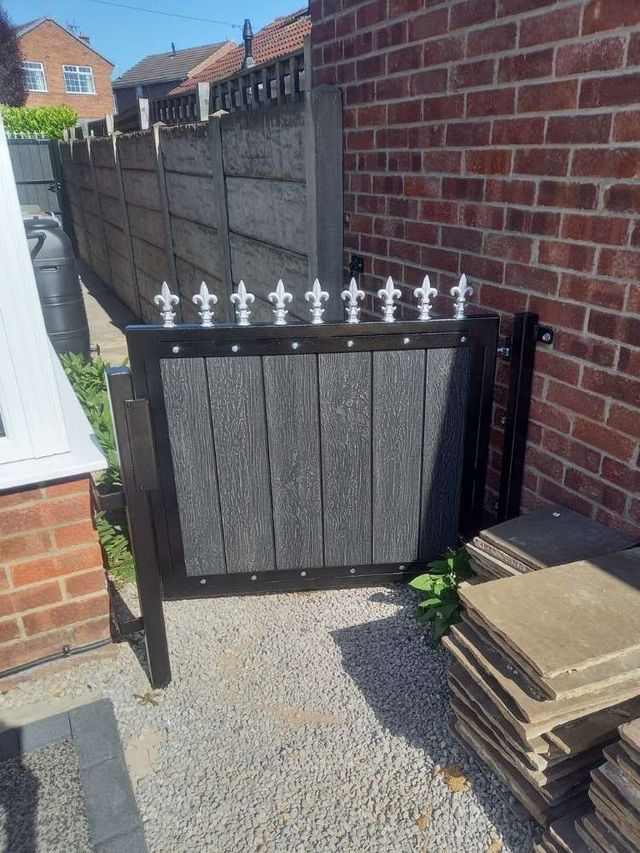
Silver finials, front garden
A low front gate with silver finials rather than black — a small change that lifts a plain leaf considerably.
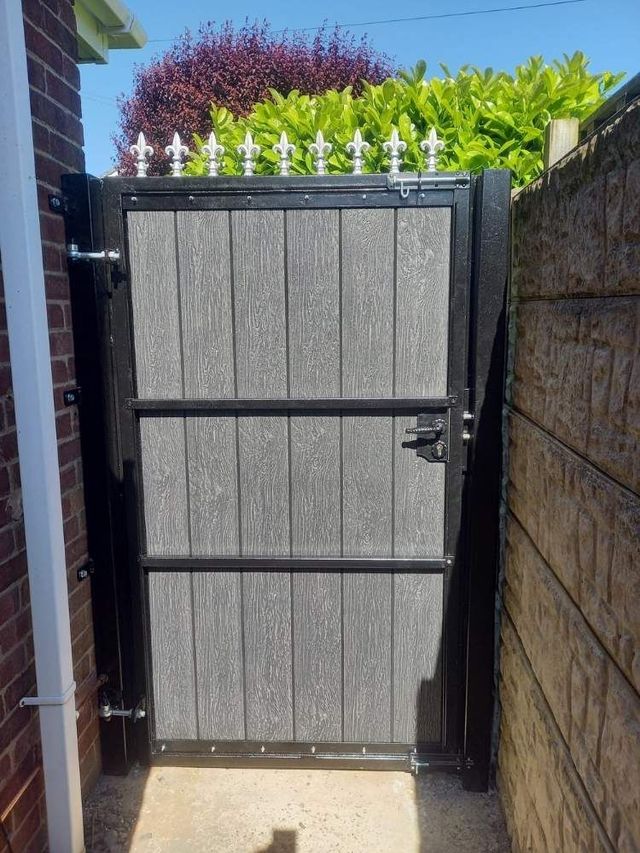
The same detail, from inside
Worth seeing the back of a gate. The frame, bracing rails and hinge bolts are what carry the leaf — the boards are just the face.
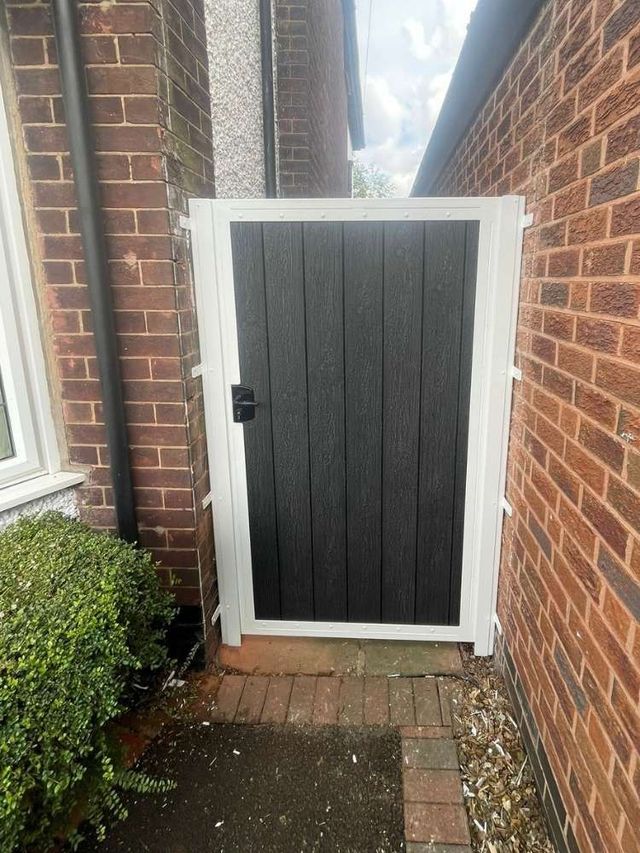
White frame to match the windows
The frame does not have to be black. Here it was finished white to match the window frames either side of the passage.
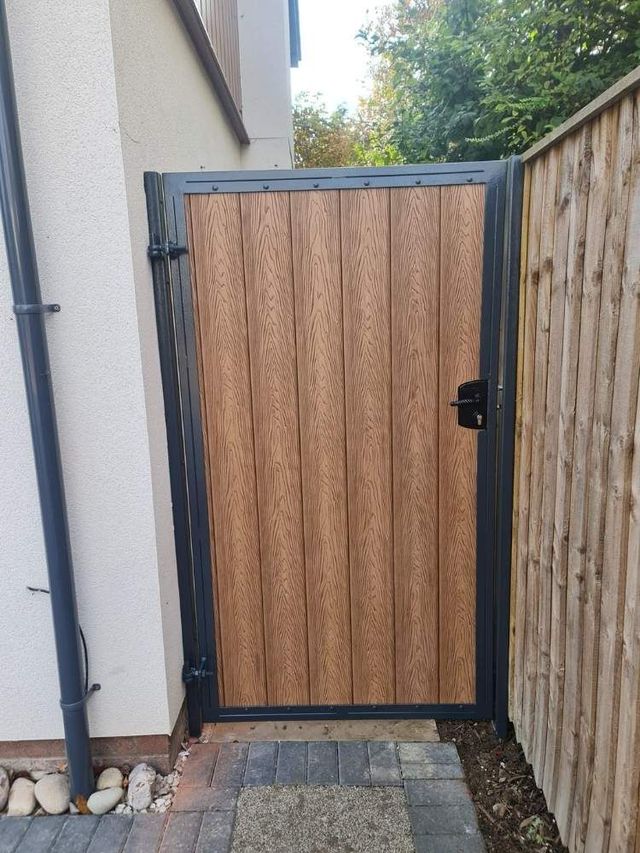
Walnut in an anthracite frame
Warm board against a cool frame. Choosing the two separately is where a made-to-order gate beats a stock one.
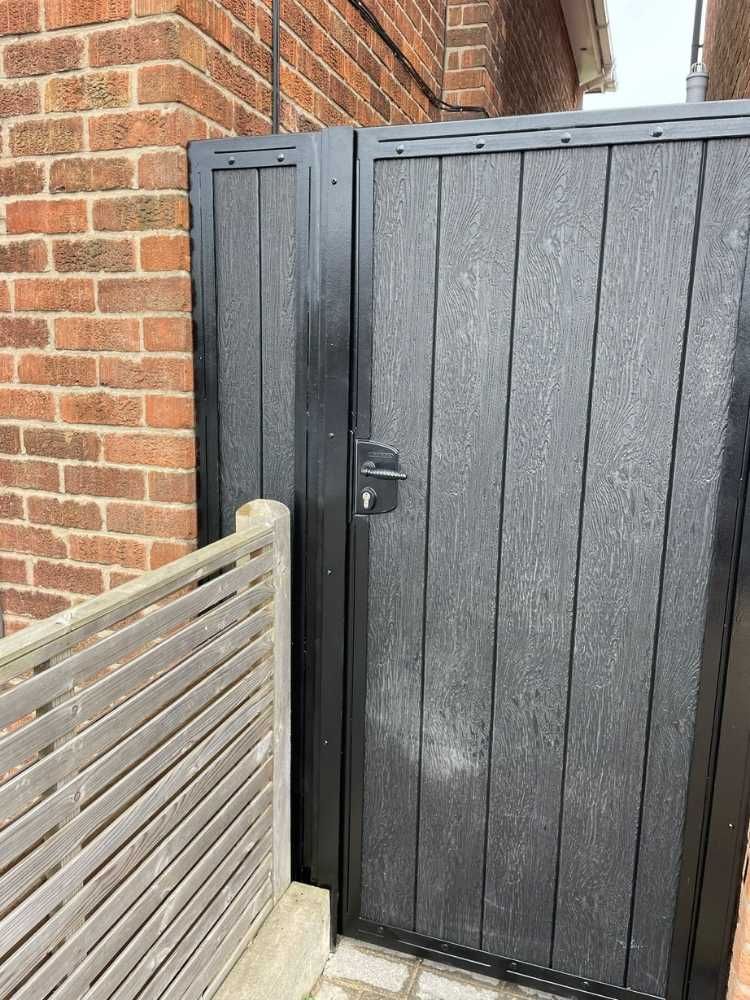
Gate with a matching infill panel
Where an opening is wider than a sensible single leaf, a fixed panel takes up the difference rather than the gate carrying it.
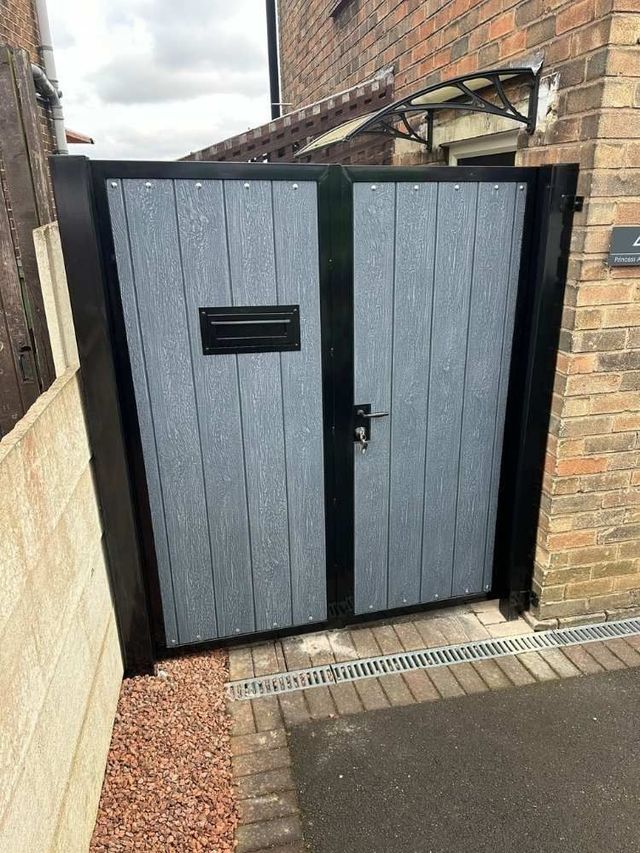
With an integrated post box
The post box set into the fixed panel rather than the moving leaf, so nothing hangs off the hinge side.
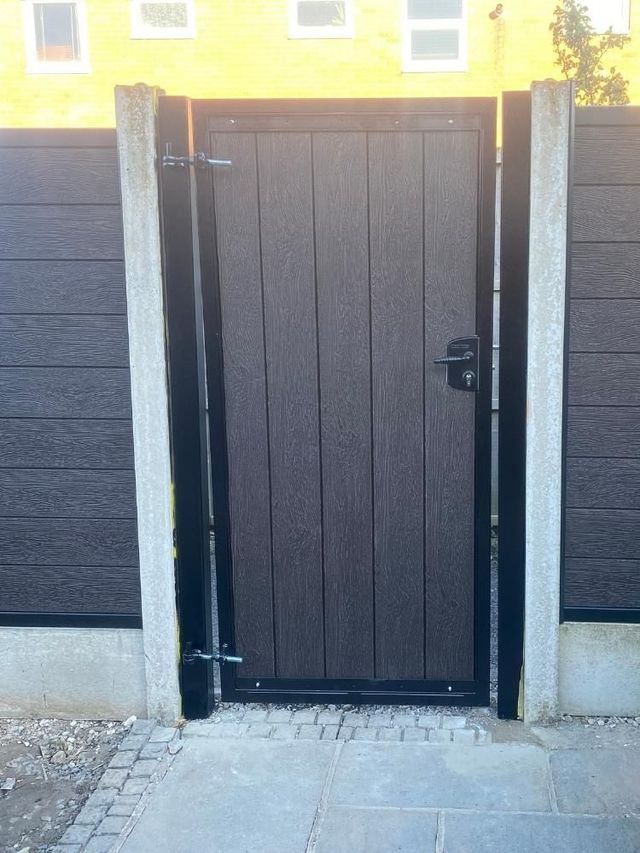
Hung between matching fencing
Gate and panels from the same batch, hung between existing concrete posts. Ordered together, the colour and grain match.
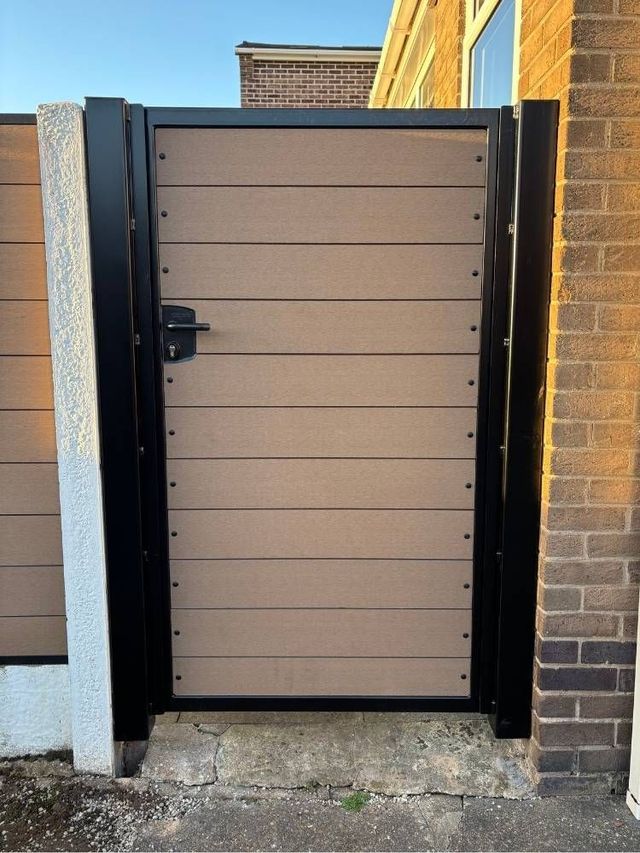
Horizontal boards
Boards run horizontally rather than vertically. Same materials, noticeably more contemporary, and it reads wider than it is.
Metal Driveway Gates
Made in our own workshop in steel, cut, welded and powder coated before they come anywhere near your drive. Bar gates for light and visibility, sheet steel where privacy matters — and the decorative work, finials, rings and gilding, all added individually rather than bought in as a panel.
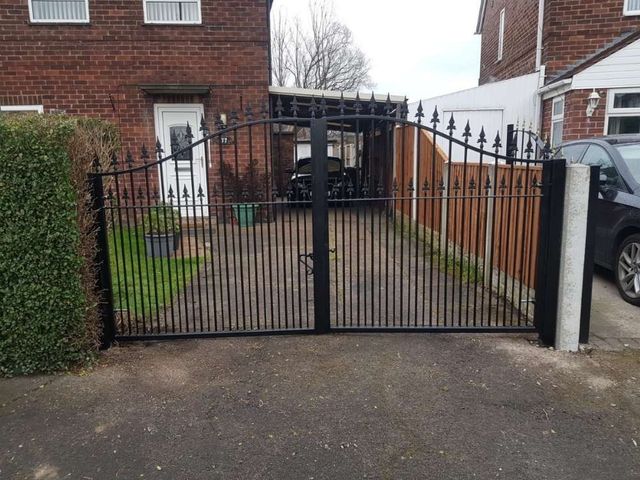
Arched with spear finials
Vertical bar gates with an arched head and cast spear finials. The arch is formed in the frame, so the bars stay vertical and the head still reads level from the road. Bar, sheet and finial options are covered on the metal driveway gates page.
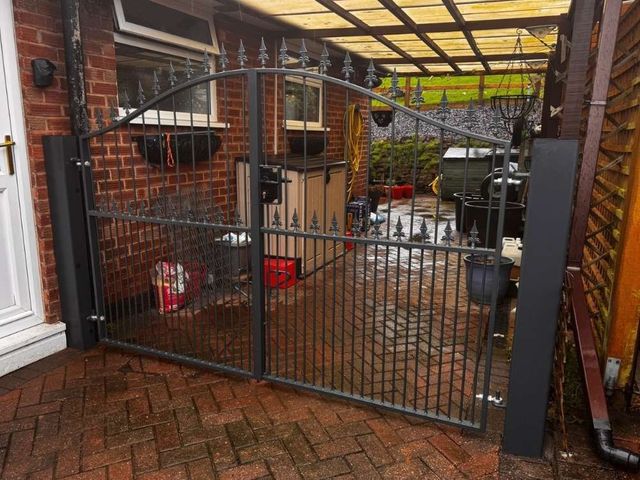
Arnold, from inside
Powder coated anthracite rather than black. Photographed from the drive, where the gate is seen from every day — the side most people forget to think about.
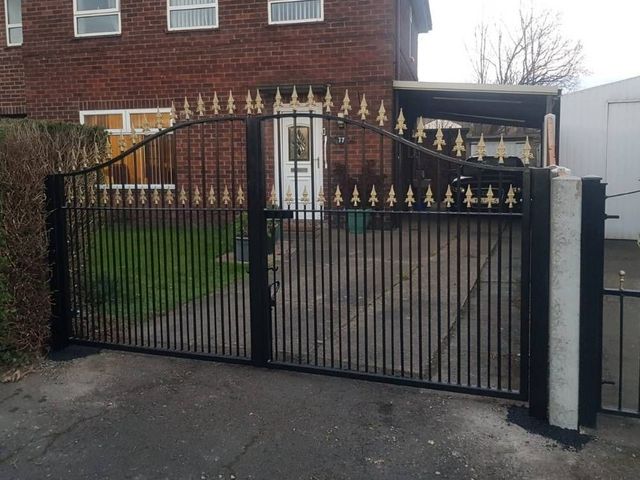
Double gold fleur de lis
Two banks of gilded fleur de lis, one at the head and one across the mid rail. Gold on black is the most requested decorative finish we make.
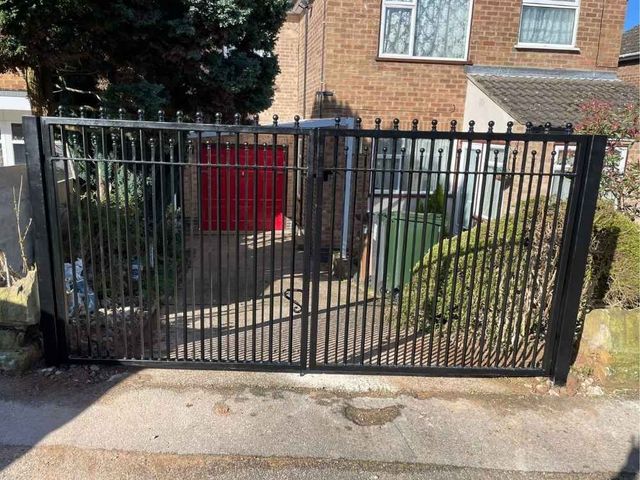
Ball tops
A softer alternative to a spear. Ball tops suit a boundary where the gate faces a footpath and a spike would be unfriendly.
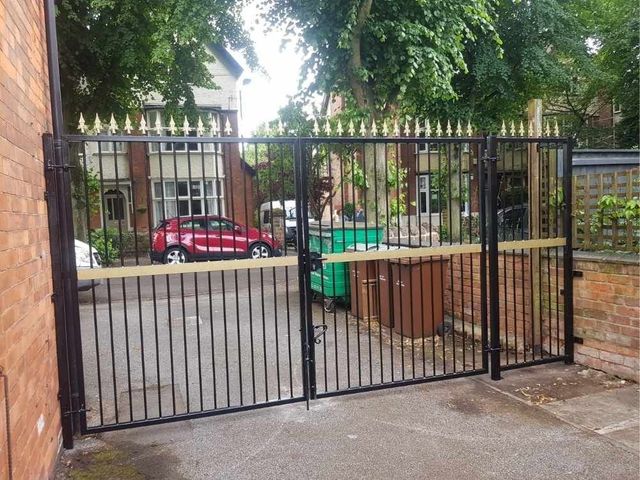
Gold fleur de lis on a flat head
The same gilding on a straight head rather than an arch. Less work in the frame, so a noticeably cheaper way to get the same detail.
Ring detail and finials
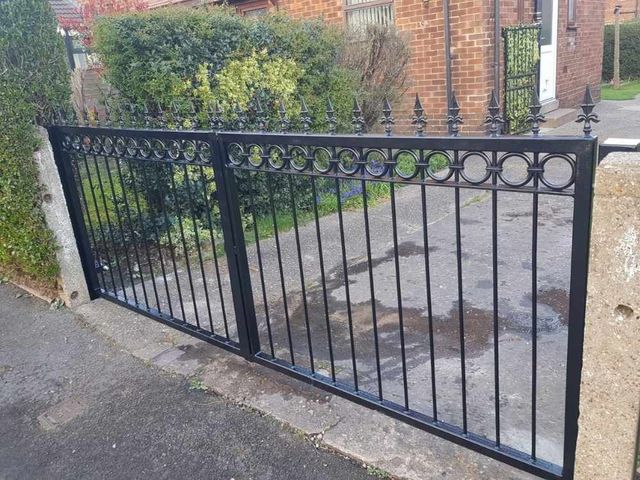
A band of rings across the head with finials above. Every ring is formed and welded in individually, which is where the hours go on a gate like this.
Offset leaves
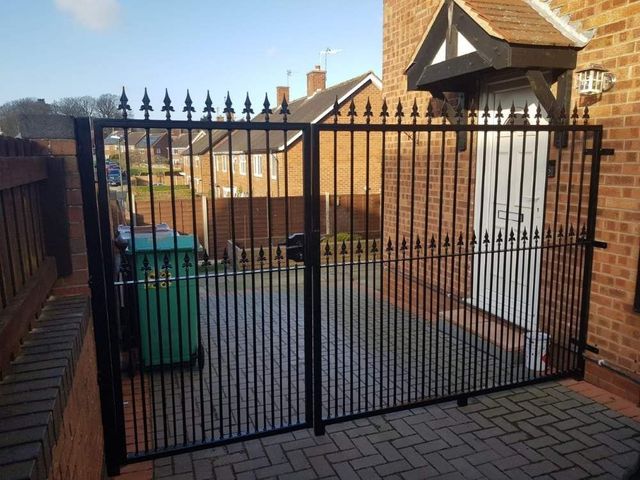
The leaves are deliberately unequal. Where a drive is not centred on its opening, two matching halves would leave the join in the wrong place — offsetting them puts it where it belongs.
Solid steel, Sherwood
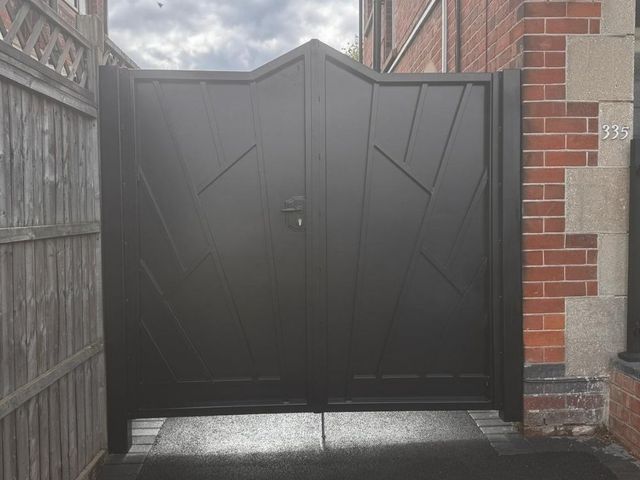
Sheet steel rather than bar, with the design cut and welded into the face. Full privacy and a very different look — closer to a door than a railing.
Metal Railings
Made in our own workshop rather than ordered in as panels, which means bar spacing, bay widths and the height of each section are set to your boundary rather than the other way round. Ball top, bow top and estate style are the three that cover most gardens — the differences are more practical than decorative.
Ball top, Long Eaton
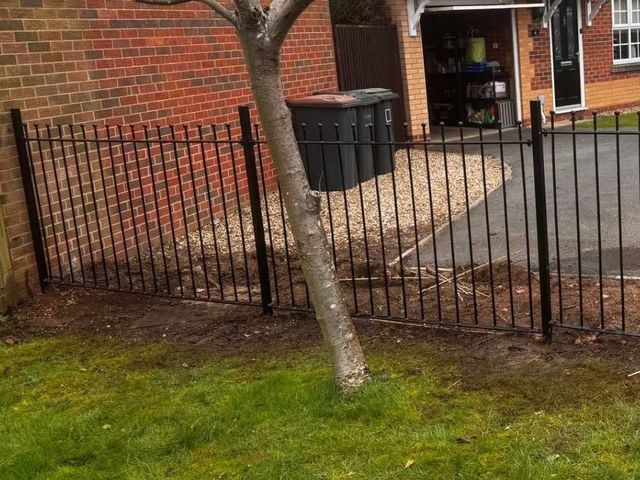
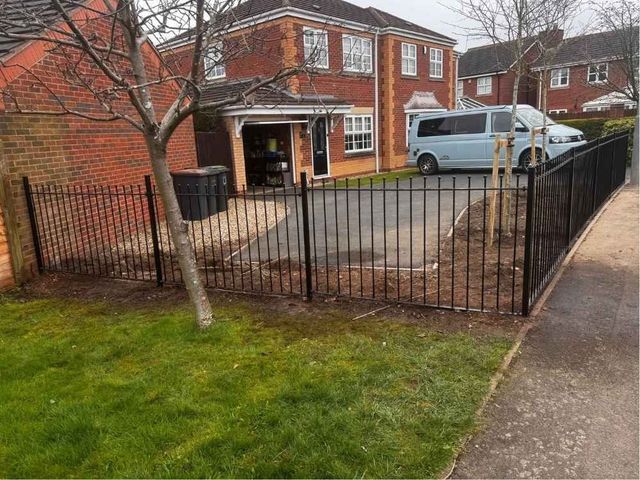
Ball tops on a front boundary. Where a railing runs alongside a pavement, a rounded top is the neighbourly choice — it marks the line without presenting a row of spikes to passers by. Head details, bar spacings and heights are set out on the metal railings page.
A full front boundary
The same detail run round a whole frontage, stepping with the ground as it falls toward the pavement. Each bay is made to its own measurement rather than the run being forced to a standard bay width.
Commercial premises
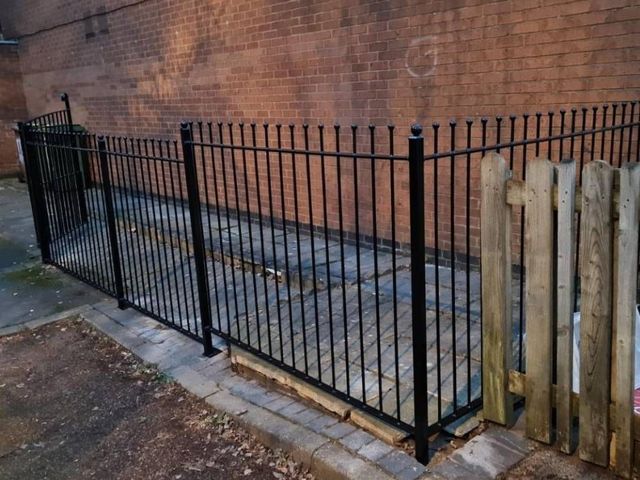
The same railing doing a harder job. Commercial boundaries take knocks a garden never does, so posts are set deeper and bays kept shorter.
Bow top
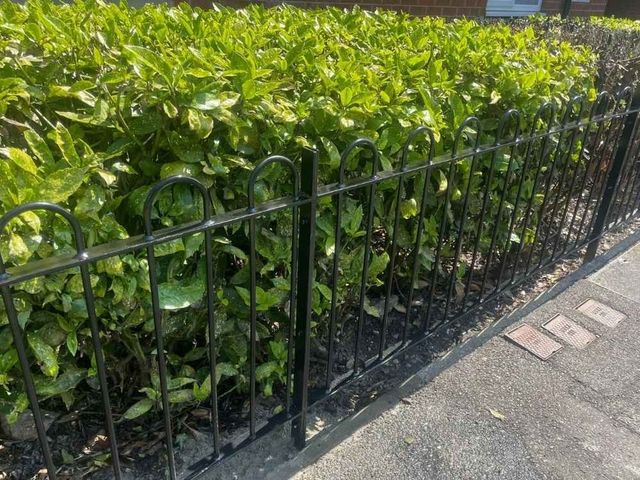
Bars looped over at the head rather than finished with a finial. Nothing to catch on and nothing sharp, which is why bow top is what goes round anywhere children play.
Estate style
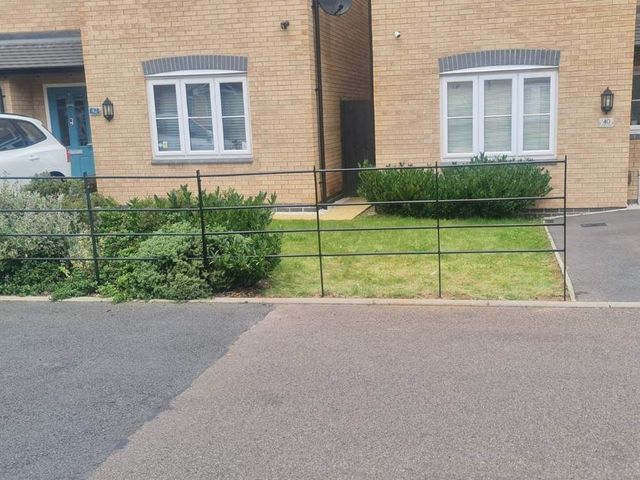
Horizontal rails between uprights rather than a run of vertical bars. It came off agricultural fencing and it barely interrupts a view, which is why it suits an open frontage.
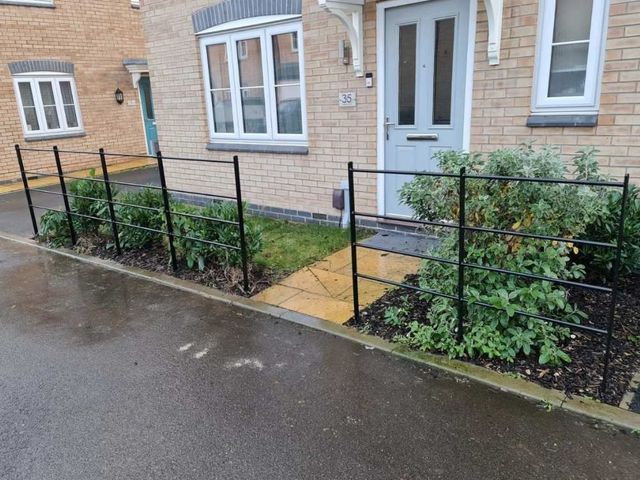
Estate railings on a terrace
The same style along a terrace of frontages. It defines each garden without walling any of them off — useful where an estate covenant restricts what you can put up at the front.
Metal Handrails
Handrails are the one thing we make where there is a standard to work to rather than a look to achieve. Guarding is expected wherever there is a drop of more than 600mm, and a handrail sits between 900mm and 1000mm from the pitch line. We build to those figures as our default, and every rail is made to the ground it sits on — steps and slopes are never quite what a drawing says they are.
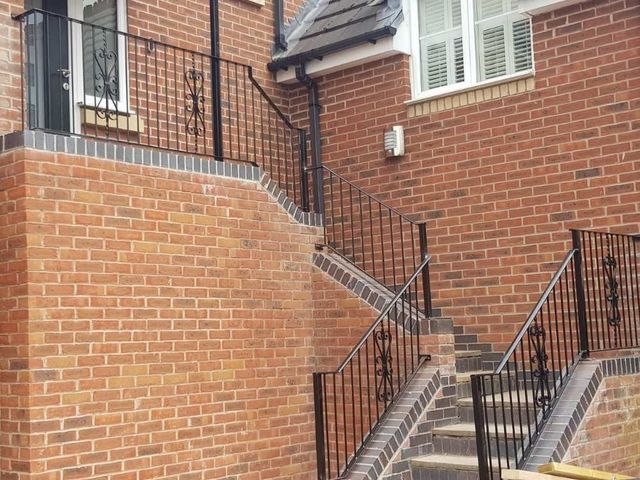
Steps and balcony guarding
Two flights and a raised landing, handrailed and guarded together. Where there is a drop of more than 600mm, guarding stops being a choice — and a landing takes a higher figure than the flight below it. These are made in the same workshop as our metal railings.
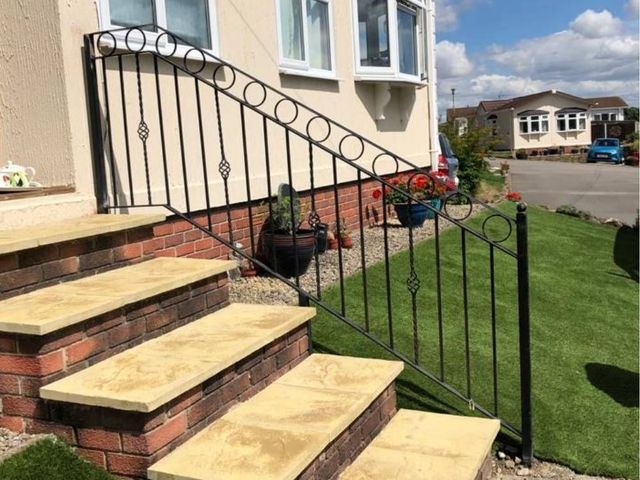
Steps to a front door
Rings and twisted bar worked into the infill. The decorative element sits inside the frame rather than on top, so it adds nothing to the height and nothing to catch a sleeve on.
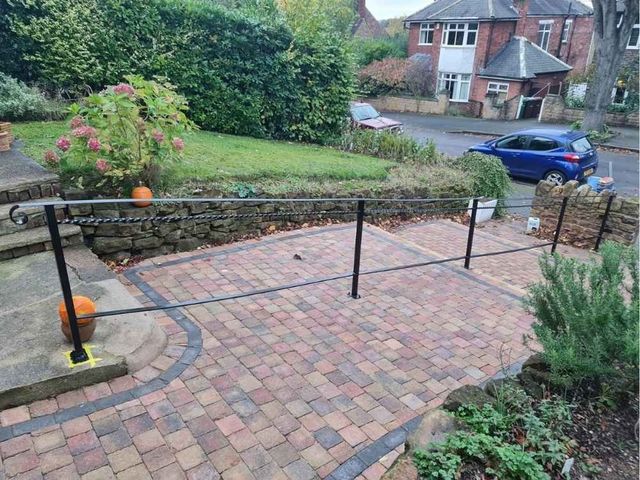
Across a change of level
A run following the edge of a paved area where it steps down. Handrails are usually thought of as a stairs thing, but most of the ones we make are for a single awkward level change.
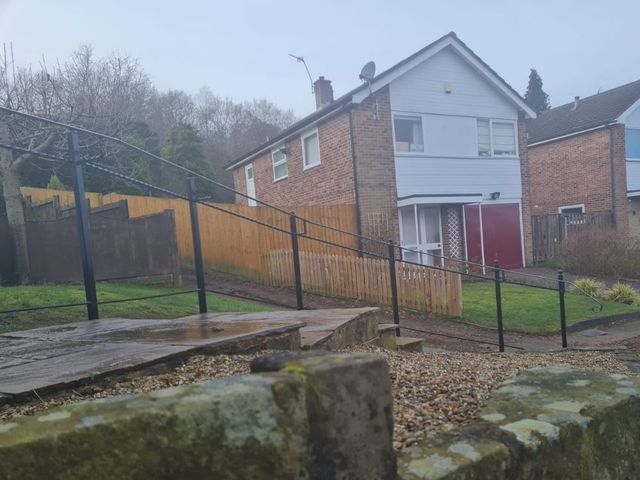
Down a sloping path
A continuous run down a long slope, in sections so it follows the fall without the top rail wandering. Getting the pitch right along the whole length is the hard part of a job like this.
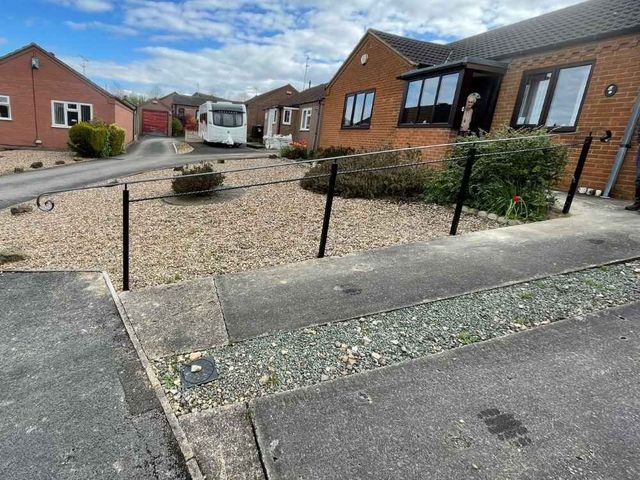
Across a front garden
A rail put in for the walk from the drive to the door. This is the most requested handrail job we get, and it is almost always about somebody staying in the house they are in.
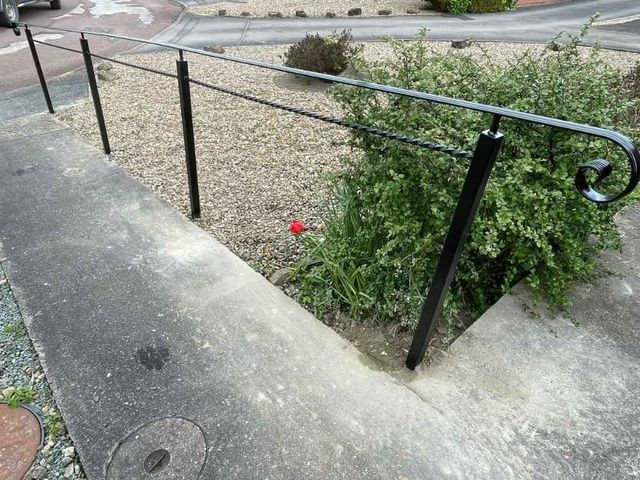
Twisted bar and a curl end
The curl at the end is not decoration. A rail that stops square leaves a blunt end at hand height; curling it round returns the end safely and gives you something to hold at the last step.
Garden & Wooden Fencing
Most timber boundaries come down to a handful of panel types, and the differences are practical rather than decorative. Tongue and groove interlocks and looks the same from both sides. Closeboard overlaps, and comes either built in place so it follows the ground or as a panel dropped between concrete posts. Picket and trellis let light and wind through instead of standing against them. Hit and miss does the same while still blocking the view, and slatted trades a little of that privacy for a cleaner line. What any of them is fixed to matters more than which one you choose.
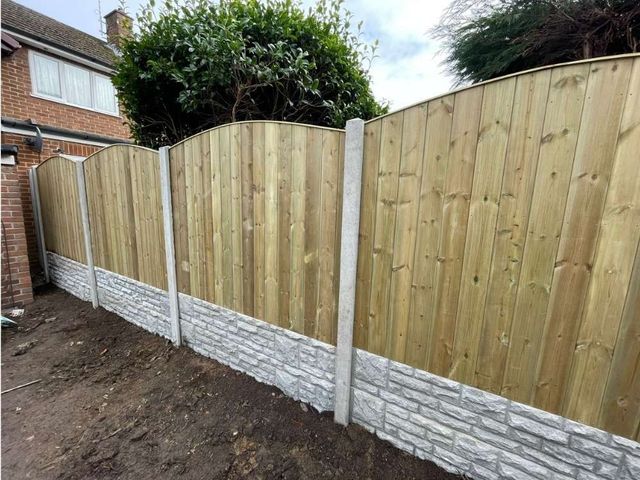
Arched tongue and groove
A convex head on each bay rather than a straight top. It lifts a long run and costs very little more, because the shape is cut into the frame rather than the boards. The panel types and heights are set out on the garden fencing page.
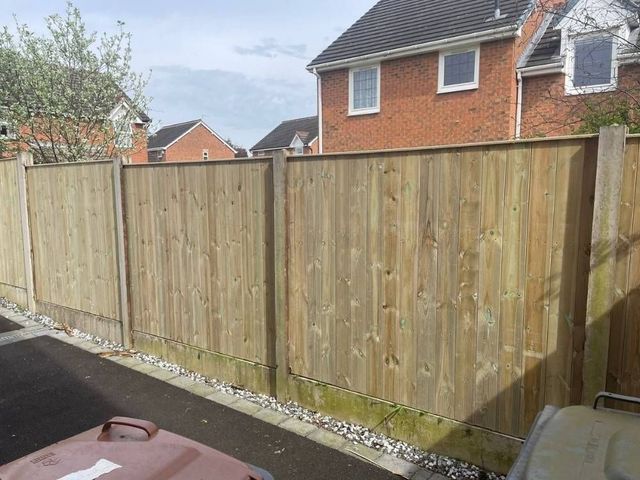
Flat top boundary run
The same panel with a straight head. Boards interlock rather than overlap, so there is no gap to see through at any angle and it looks the same from both sides.
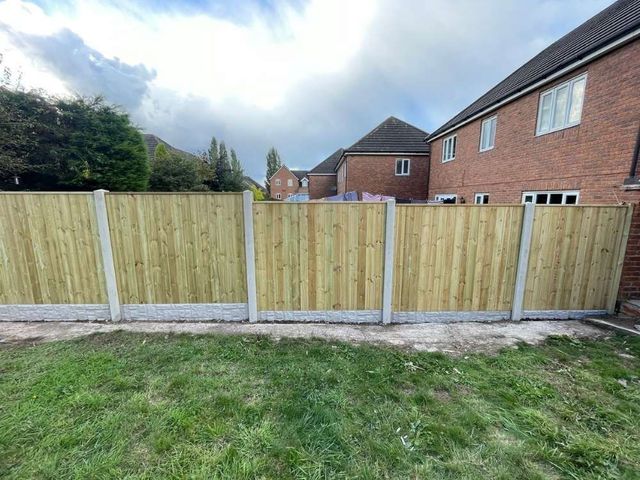
On concrete posts and gravel boards
Fitted into concrete posts with rock-faced boards at the base. The panel is the part you choose; the posts and boards are the part that decides how long you keep it. There is more on what sits under a fence on the gravel boards page.
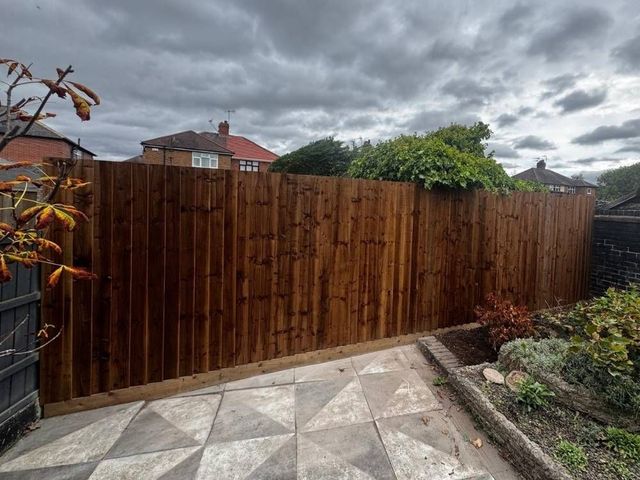
Closeboard, dark treated
Featheredge boards fixed to rails and built in place rather than dropped in as panels, so the run follows the ground instead of stepping over it.
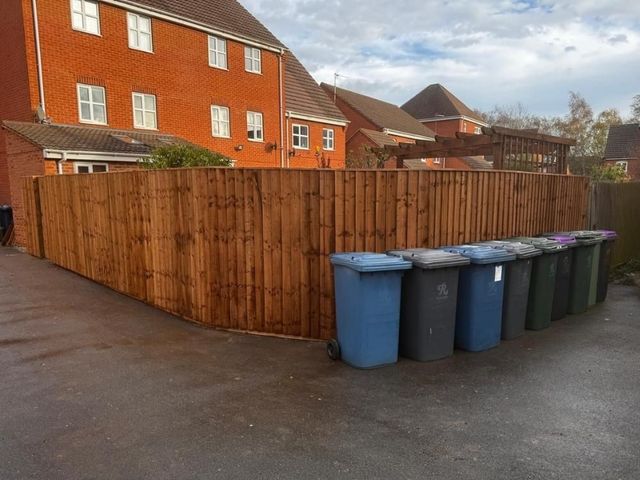
Enclosing a rear service area
A long run turning two corners. Built in situ, a corner is just another post; with pre-made panels it is a compromise.
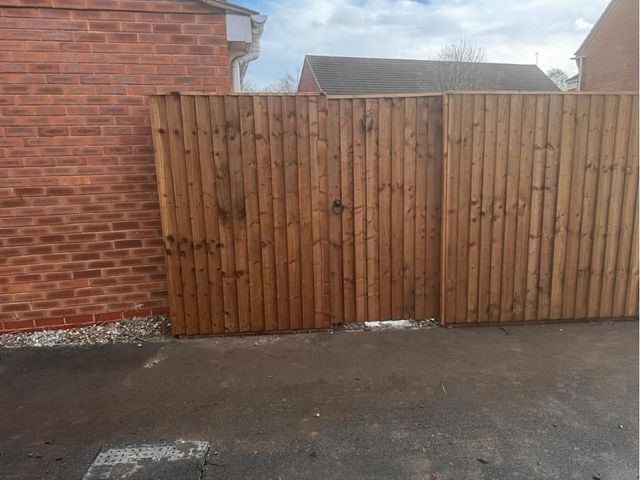
With a matching gate
Gate built from the same boards and rails as the run either side, so the grain, height and colour carry straight through the opening.
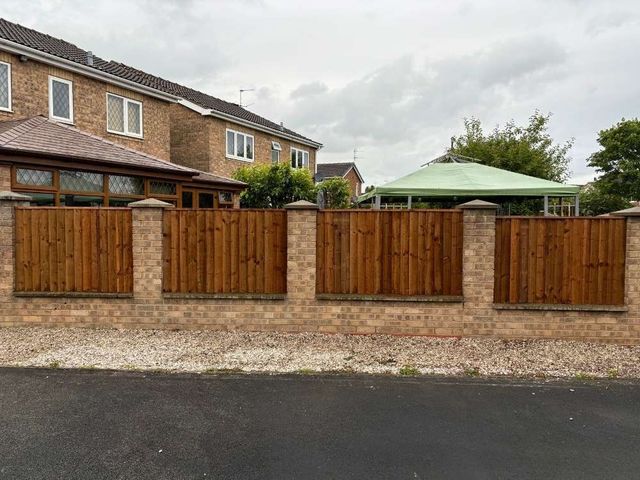
Between brick pillars
Each bay made to its own opening. Pillars are never spaced to a standard panel width, which is why a stock panel always leaves a gap at one end.
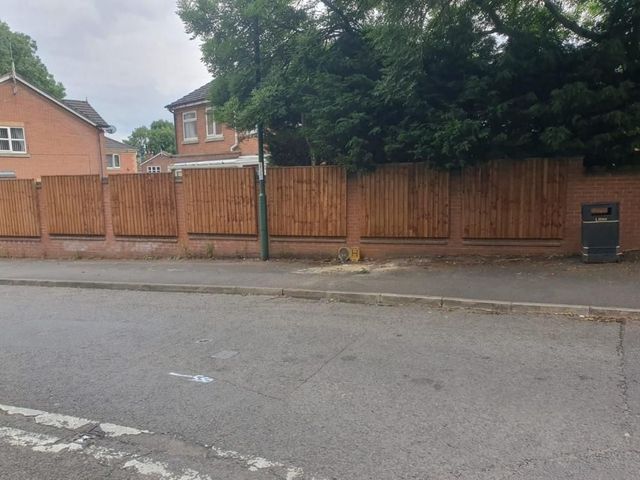
Raising an existing wall
Height added above sound brickwork rather than the wall coming down. Cheaper, quicker, and the wall outlasts the fence above it.
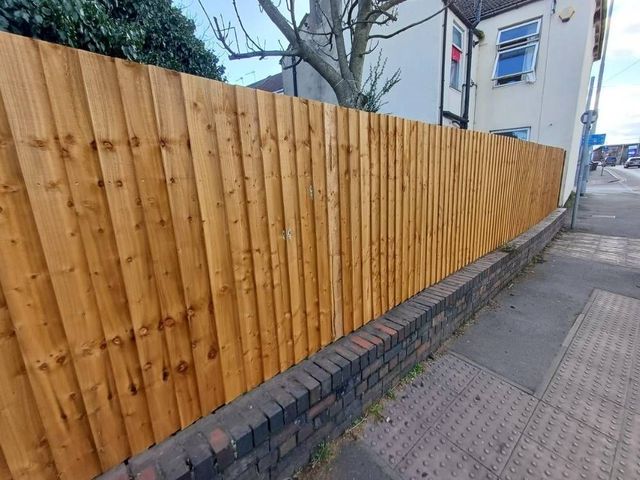
Wall mounted along a pavement
Fixed to the wall rather than dug into the ground. Where a boundary fronts a footpath the total height is measured from the pavement, wall included.
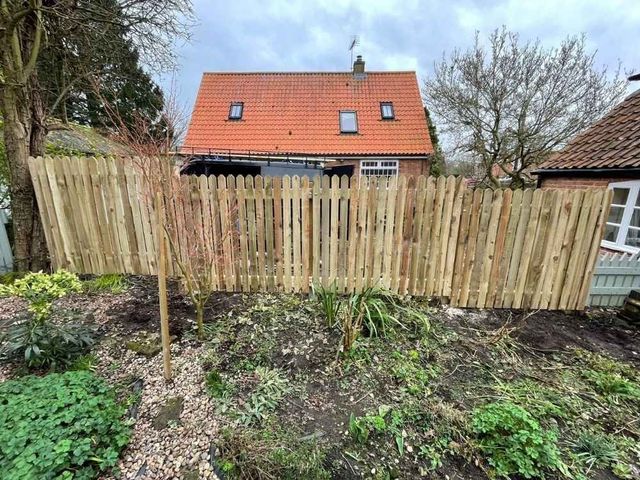
Picket at full fence height
Picket does not have to be knee height. At full height the gaps still let light and wind through, which is why it suits an exposed garden where a solid panel would act as a sail. Heights and pale spacings are covered on the picket fences page.
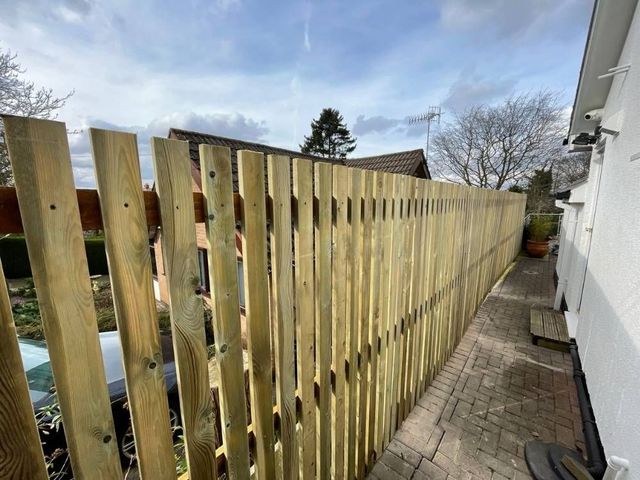
Down a narrow side passage
A solid fence here turns a side passage into a dark corridor. The gaps keep daylight on the path and still mark the boundary clearly.
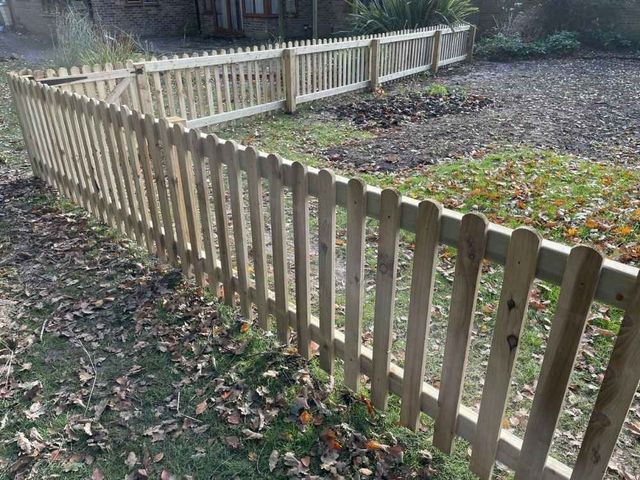
Enclosing part of a plot
Dividing ground rather than marking a boundary — a dog run, a play area, a section kept separate from the rest. Built in short stepped bays so it follows ground that is nowhere near level.
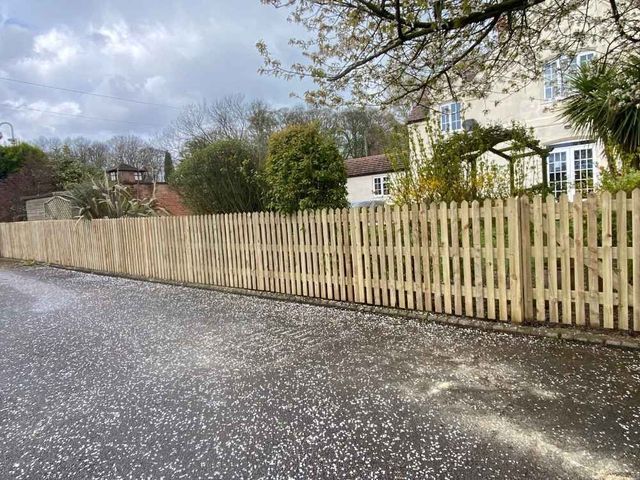
Frontage with a matching gate
The run steps down with the fall of the lane rather than staying level and leaving a wedge of daylight at one end. The gate is made from the same pales at the same spacing, so it reads as part of the run.
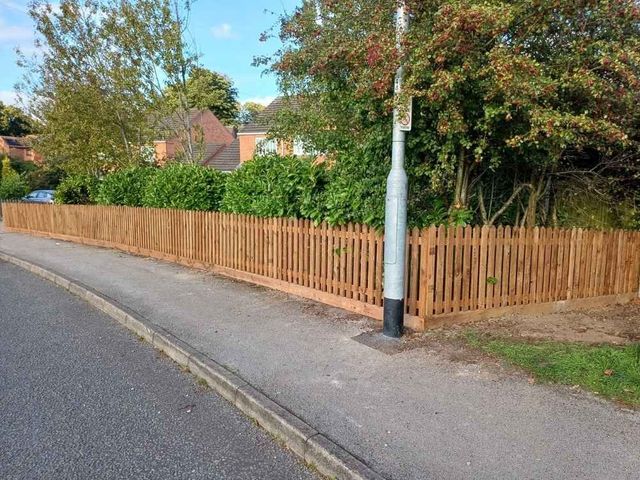
Brown treated, roadside boundary
Same timber, brown treatment instead of green. Kept low deliberately: anything over one metre next to a road used by vehicles normally needs planning permission under permitted development, so a low picket avoids an application. Worth confirming with the council for your own frontage.
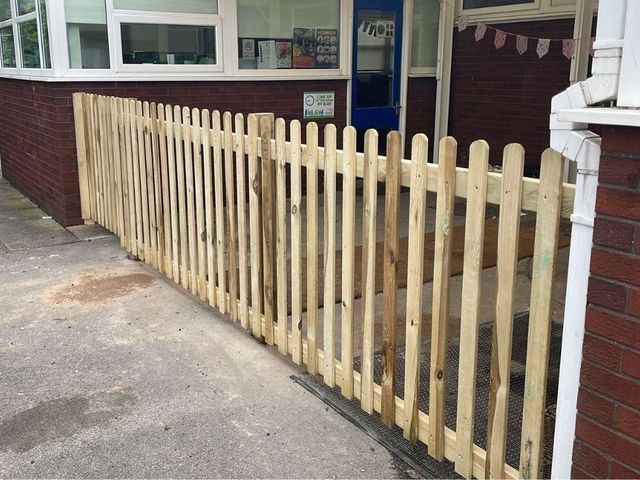
At a Nottingham school
Rounded pale tops rather than points, and fixed down onto hard standing instead of dug in, because there was nothing to dig into. The run steps with the slope of the entrance. Work on school sites is covered separately under school fencing.
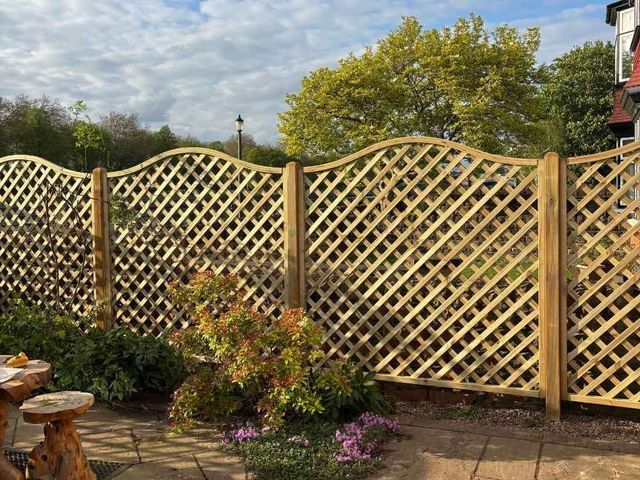
Arched diamond trellis
Full height trellis used as the boundary itself rather than as a topper. The wave head runs across three bays, so the shape only reads properly on a long run — on a single panel it looks like a mistake. Panel styles and heights are on the trellis page.
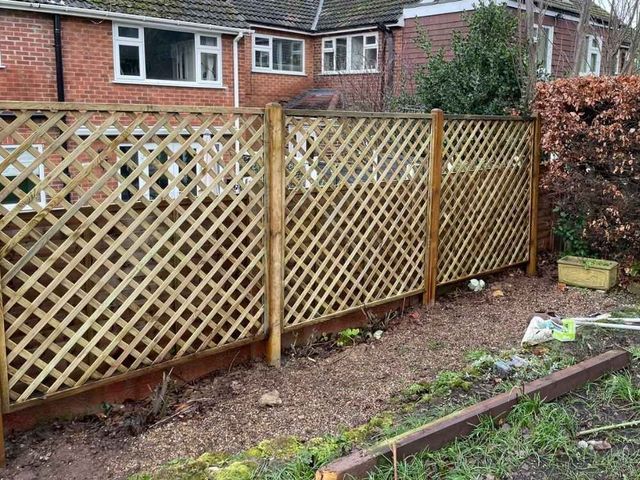
Set alongside an existing wall
Posts dug in beside the old brickwork rather than fixed through it. Where a wall is sound but nobody wants to load it, standing the fence next to it is cheaper than rebuilding and leaves the wall untouched.
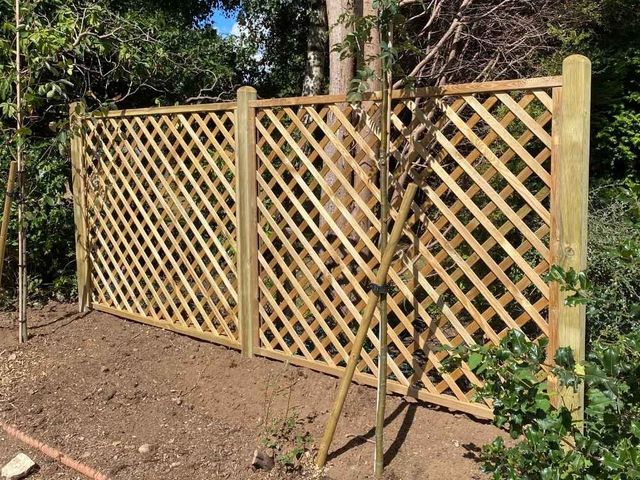
Partitioning a section of garden
Splitting one garden into two areas rather than fencing a boundary. Trellis is the usual choice here because it divides the space without making either half feel smaller.
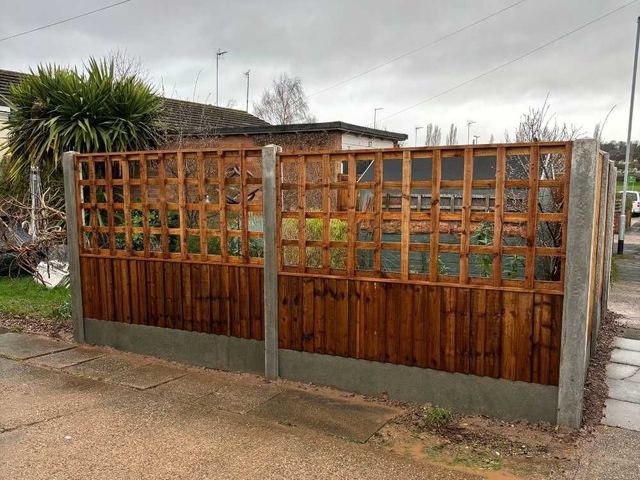
Board with a trellis top
Solid to shoulder height, open above. It gives the privacy of a closeboard panel and takes far less wind at the top, which is where a fence is levered hardest.
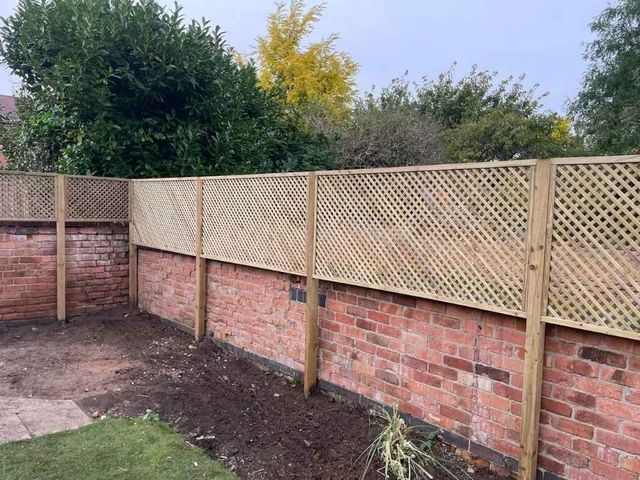
Raising a wall — garden side
Posts bolted down the face of the brickwork and trellis between them. Trellis is the right thing to add to an old wall because the wind goes through it; a solid panel up there turns the whole wall into a sail.
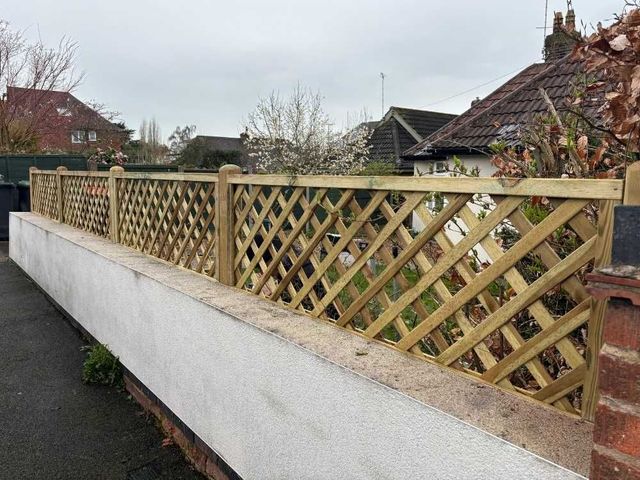
The same job — roadside
The road side of the wall in the previous photo, stepping down with the pavement. Worth knowing before you add to a boundary: trellis counts towards the overall height when a boundary is measured for planning, and the permitted height is lower next to a road. Check with the council if you are anywhere near the limit.
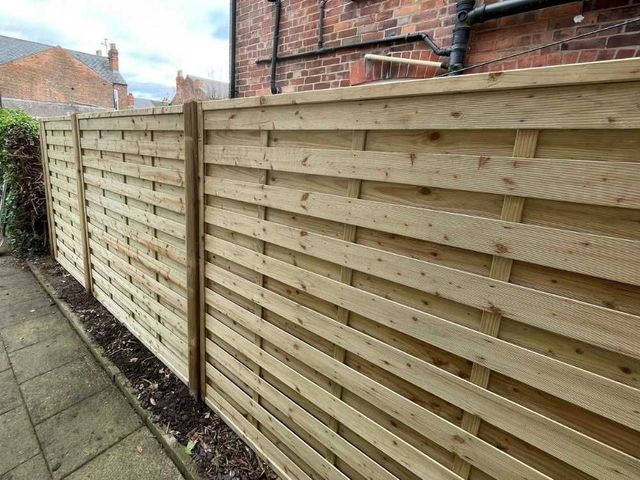
What hit and miss actually is
Boards fixed alternately to each side of the rails, so every gap on one face has a board behind it on the other. You cannot see through it, but air can pass straight through, which is why it stays up in an exposed spot where a solid panel gets blown out.
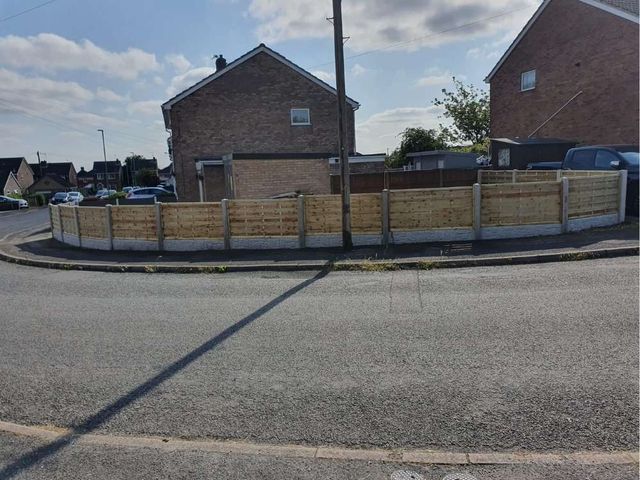
Around a curved corner plot
A curve is built as a series of short straight bays, each set at a slight angle to the one before. Concrete posts and gravel boards throughout, so no timber is in contact with the ground.
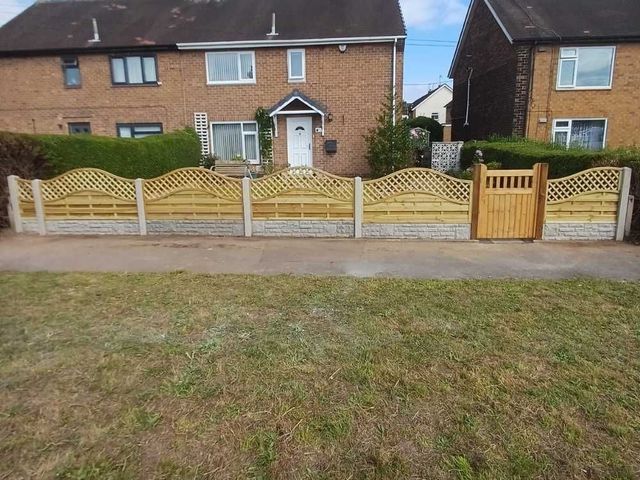
Arched tops on a frontage
The wave repeats in every bay, so the line carries the full width of the frontage rather than stopping at one panel. Concrete posts, rock faced gravel boards and a gate built to match.
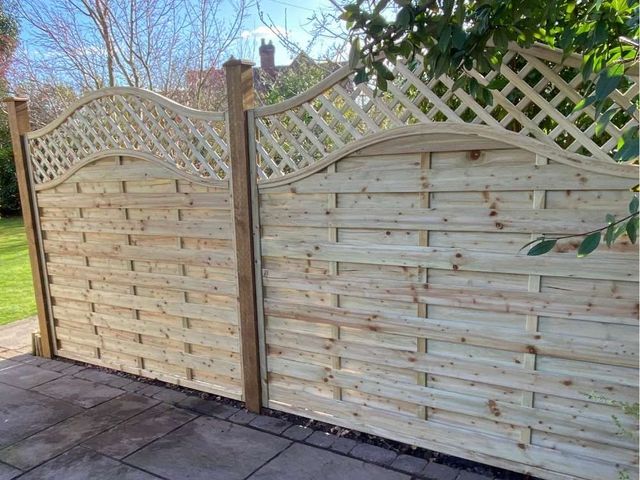
Arch and trellis in one panel
The trellis is part of the panel rather than a topper bolted on above it. No joint line running across the fence, and nothing sitting up there to work loose.
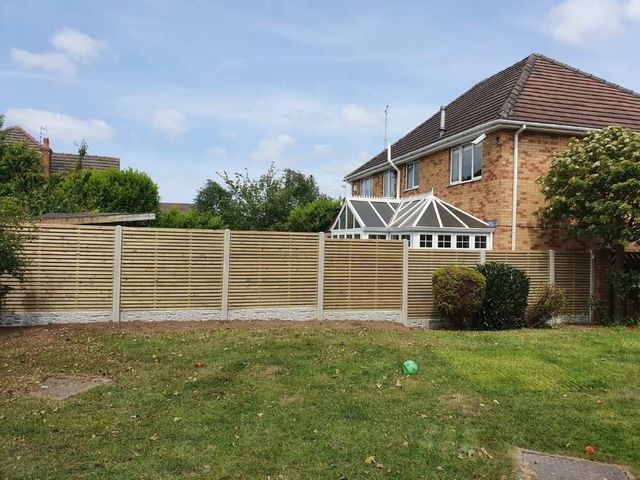
Slatted in concrete posts
Concrete posts and rock faced gravel boards. If a panel is ever damaged it lifts out from the top and a new one drops in, without digging anything up.
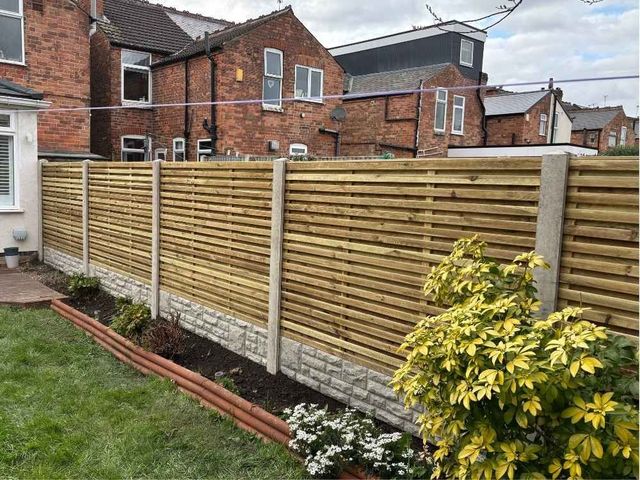
Double sided — no bad side
Slats on both faces of the frame, so it looks identical from either garden. It settles the good side and bad side conversation with a neighbour before anyone has it.
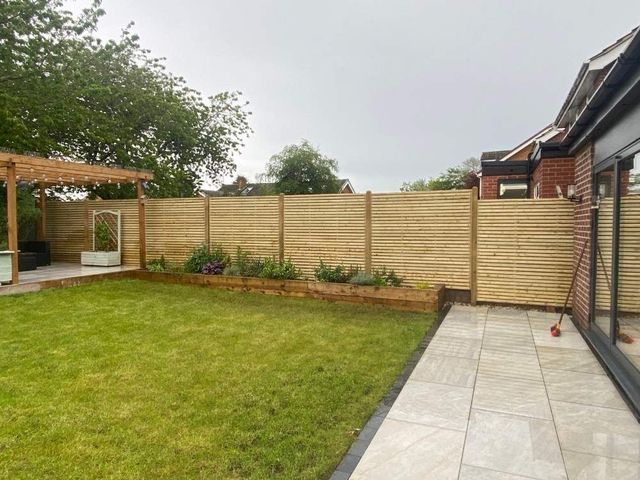
Timber posts instead of concrete
Timber posts keep the whole boundary one material and one colour. The honest trade: concrete lasts longer in the ground, timber looks better above it.
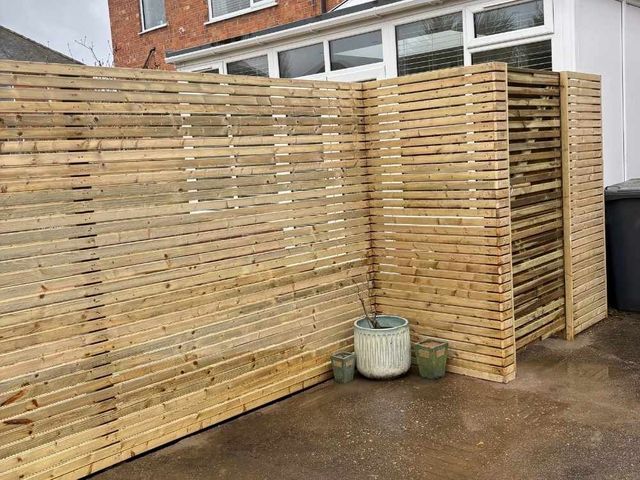
Slatted with a matching gate
The gate is built from the same slats at the same spacing, so it reads as part of the run instead of a door cut into it. The fence returns around the corner in the same detail.
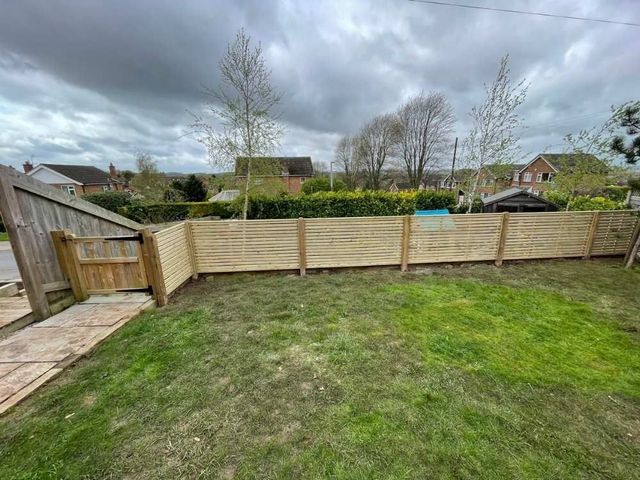
New run beside the old fence
The old grey lap panel is still standing at the left of the shot. Worth seeing the two next to each other, because that is the comparison people are actually making.
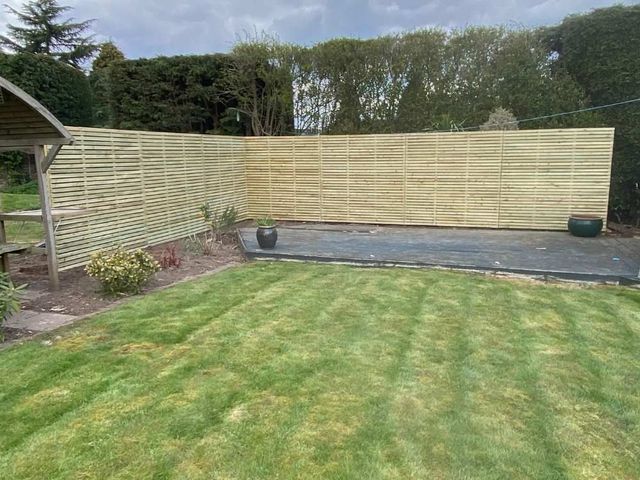
Screening a decking area
Not the boundary — the hedge behind it is. This is a screen wrapped around the decking to give the seating area some privacy without closing the garden in.
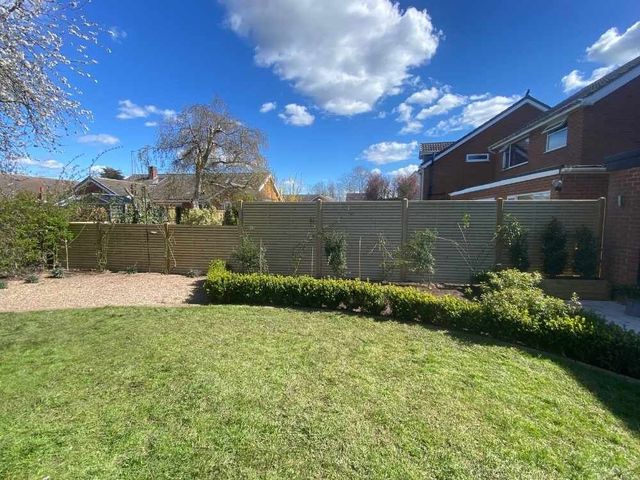
Stepped along one boundary
One boundary replaced rather than the whole garden. Each bay is kept level and stepped down to the next, which reads straighter than raking the panels to follow the slope.
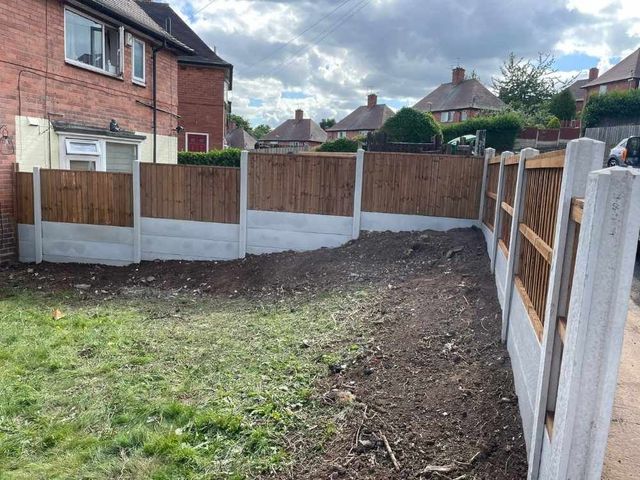
Gravel boards holding the ground
The ground on this boundary sits higher on one side. The gravel boards take the soil load, not the panels — that is what they are for, and it is why a fence with timber sitting straight onto earth rots from the bottom up.
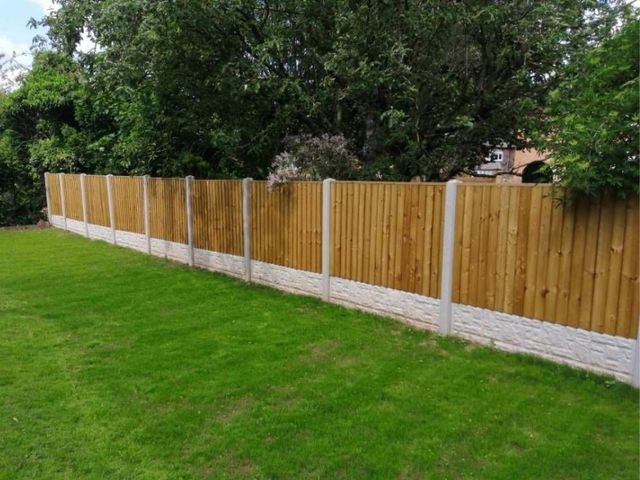
A long run, set out first
On a run this length the top line shows every mistake. The posts go in and get levelled across the whole boundary before a single panel drops in, which is slower on day one and invisible afterwards.
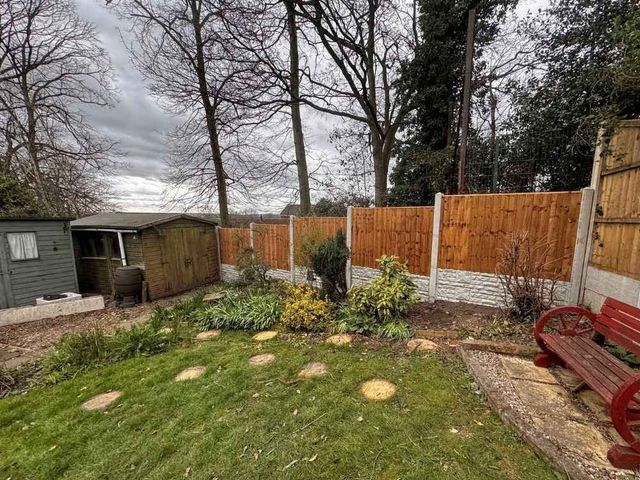
Stepped bays in Eastwood
Ground that falls across the boundary is taken in steps, each bay level and dropped to the next. The older dark fence still standing at the right is the neighbour’s, and it is not our work.
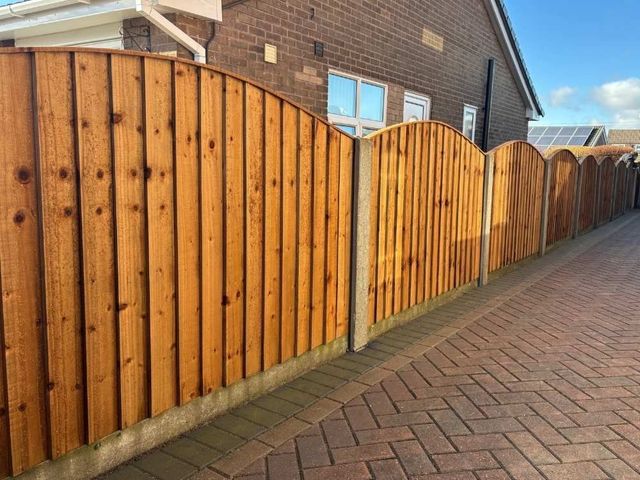
Arched tops, replacement panels
Each panel bows up through the middle, so the run reads as a series of curves rather than one flat line. The concrete posts and gravel boards were already sound here, so only the panels were replaced. Sizes and profiles are listed on the fence panels page.
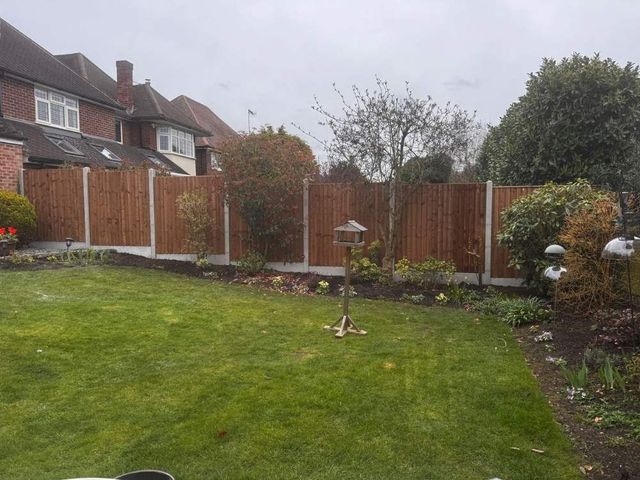
Smooth gravel boards in Wollaton
Plain smooth boards here rather than the rock faced pattern in the photos above. Both do exactly the same job — it is purely which one you would rather look at along the bottom of the garden.
Wooden Gates
Driveway pairs first, then single side and garden gates. Every driveway gate here is shown twice, from the road and from the drive, because a timber gate never looks the same from both sides and the side nobody photographs is the side that decides whether it still swings in ten years. Frame, bracing, hinges and bolts all live on the inside face.
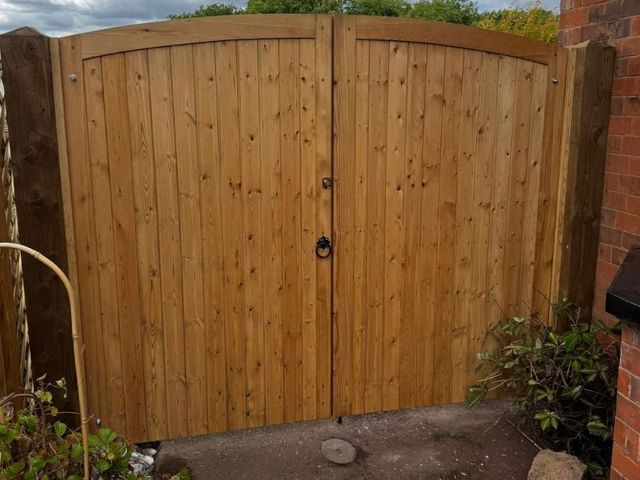
Arched pair — road side
The arch is cut through the boards and capped, so the curve is in the gate rather than sat on top of it. From this side you see the face and nothing else: no rails, no bracing, no fixings. Construction, ironmongery and sizing are covered on the wooden driveway gates page.
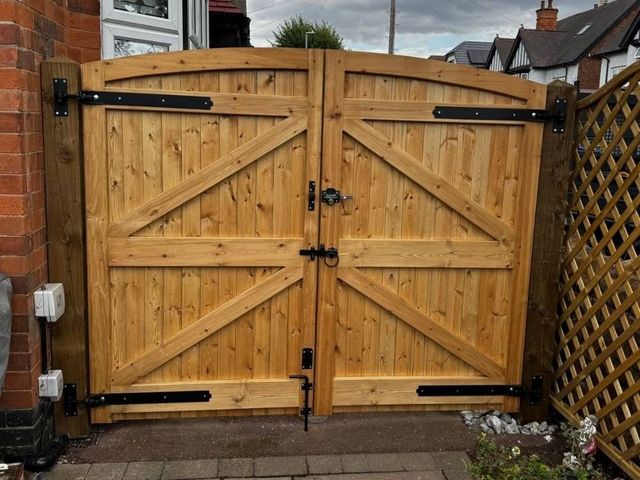
The same pair — drive side
Everything structural lives on this face. The braces run up from the hinge corner towards the latch, which is the only direction that works — put them the other way round and the gate slowly pulls itself out of square.
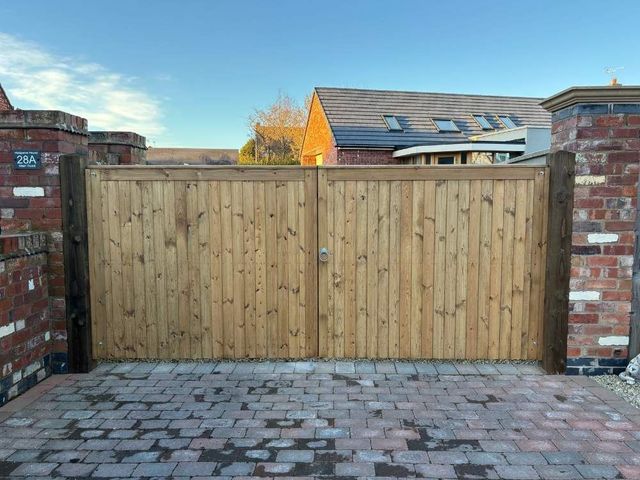
A wide opening — road side
A wide entrance means long leaves, and long leaves are heavy. The posts are the whole job here: everything the gate does for the next twenty years is decided by what it is hung on.
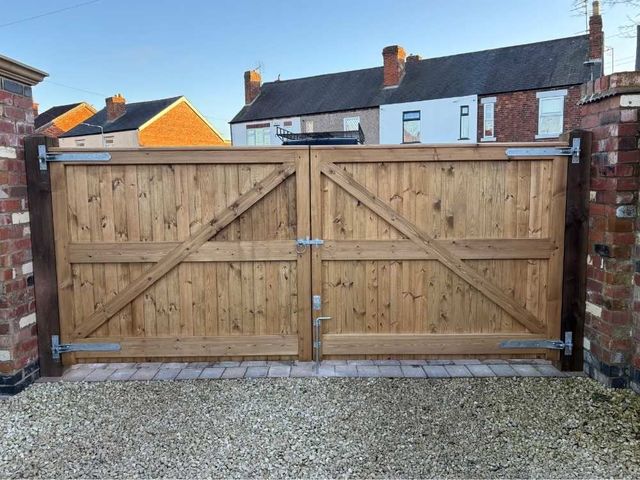
The same pair — drive side
Galvanised straps rather than painted, and a drop bolt into the ground at the meeting point. On a pair this wide the drop bolt is doing real work, not just holding the shut leaf still.
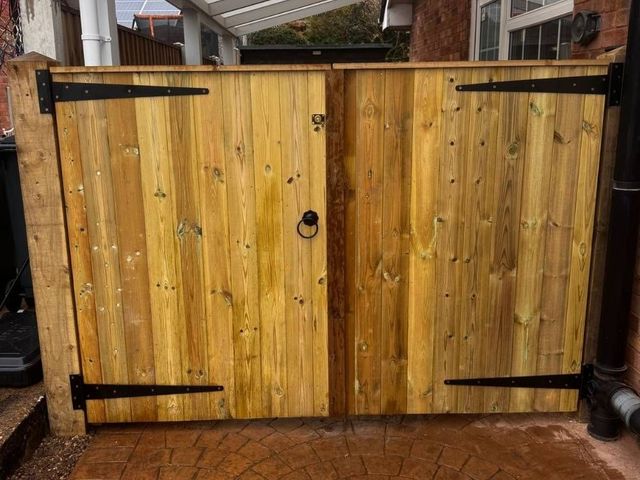
Carport gates — outside
Fitted to close off a carport rather than a drive entrance, so the height is set by the opening it sits in rather than by the boundary either side of it.
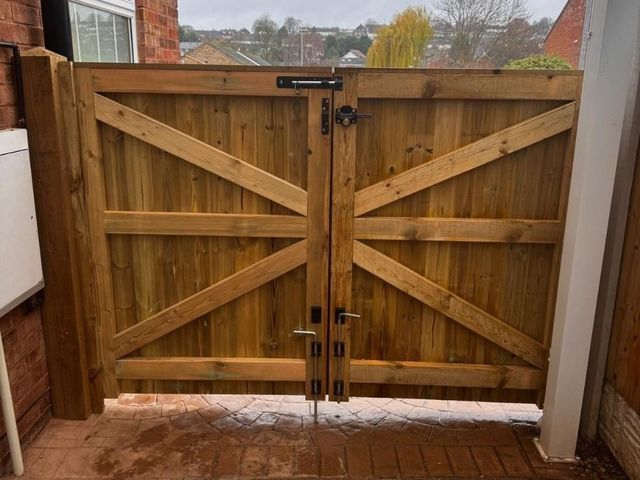
The same gates — inside
Same construction as a driveway pair, built to the width that was there. Drop bolts both leaves, because an opening between two buildings funnels wind straight at them.
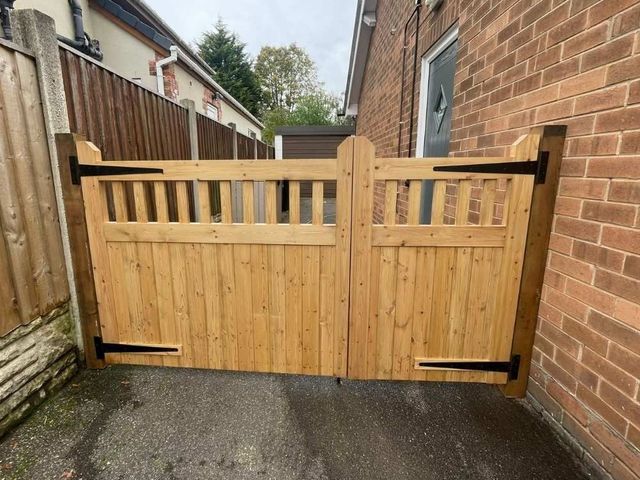
Offset pair — outside
Two unequal leaves rather than a matched pair. The narrow leaf stays bolted and the wide one is the one you actually use, which suits a drive where you open up properly once a day and walk through the rest of the time.
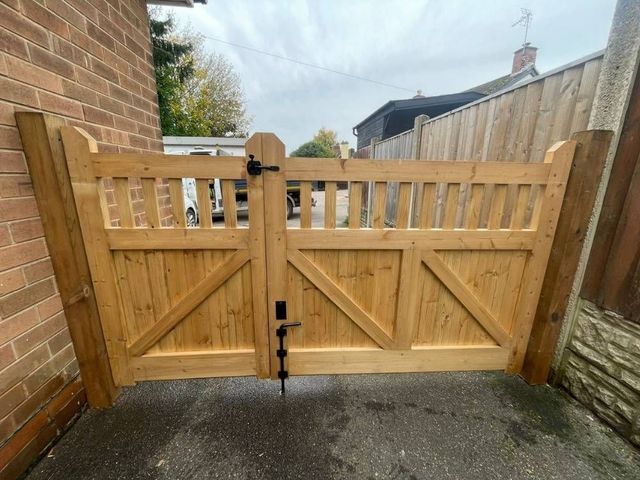
Offset pair — other side
The open spindle section keeps the top half light and lets wind through, so the wide leaf is not fighting the weather every time it is opened. Solid below for privacy, open above for everything else.
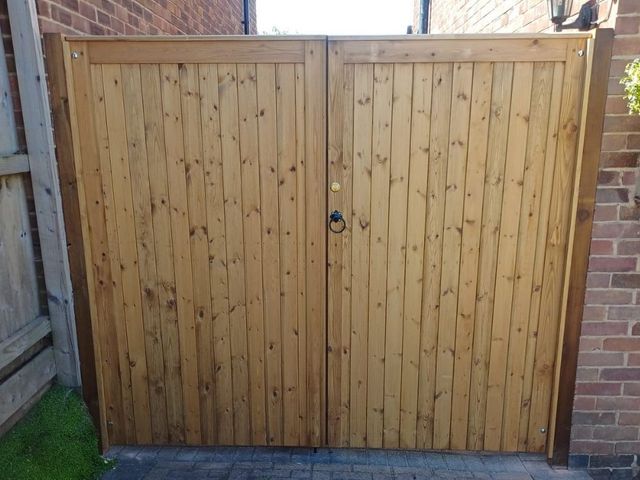
Tongue and groove — outside
Tongue and groove boards, so the joints interlock and there is no gap to see through as the timber moves with the seasons. Ring handle and a lock on the face.
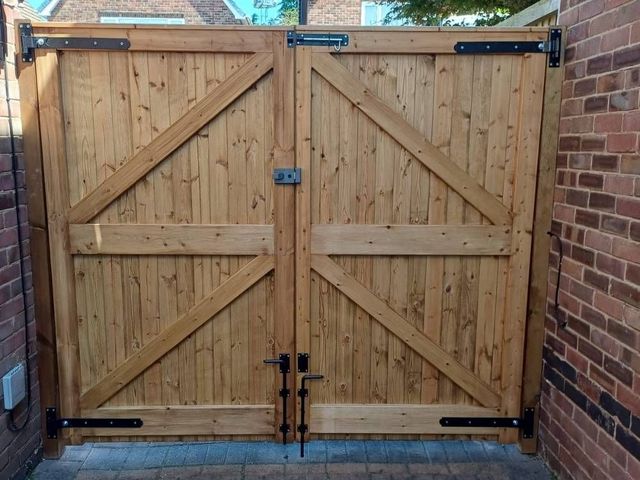
Tongue and groove — inside
The frame side. Every timber gate has a face side and a frame side — there is no such thing as one that looks identical from both, which is worth knowing before you decide which way round it hangs.
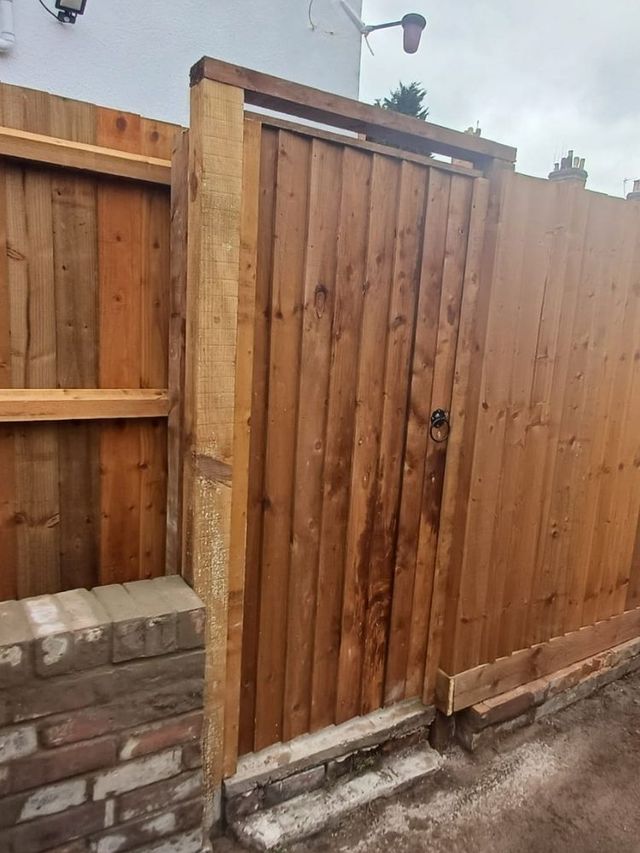
Built into the run
The gate goes in as the fence is built, framed by its own posts with a head rail across the top. Fence posts hold up a fence; gate posts take a swinging load all day — they are not the same job and they are not the same post. Single side and garden gates have their own page under wooden gates.
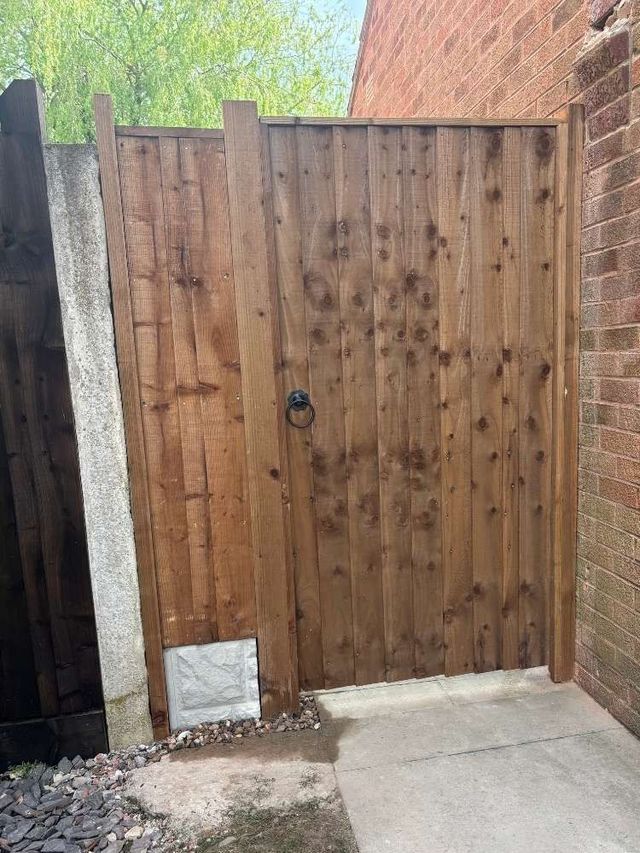
Gate plus a fixed panel
The opening was wider than a single gate should ever be, so a matching fixed panel takes the extra width. Past about a metre a single leaf starts to drop under its own weight, however well it is hung.
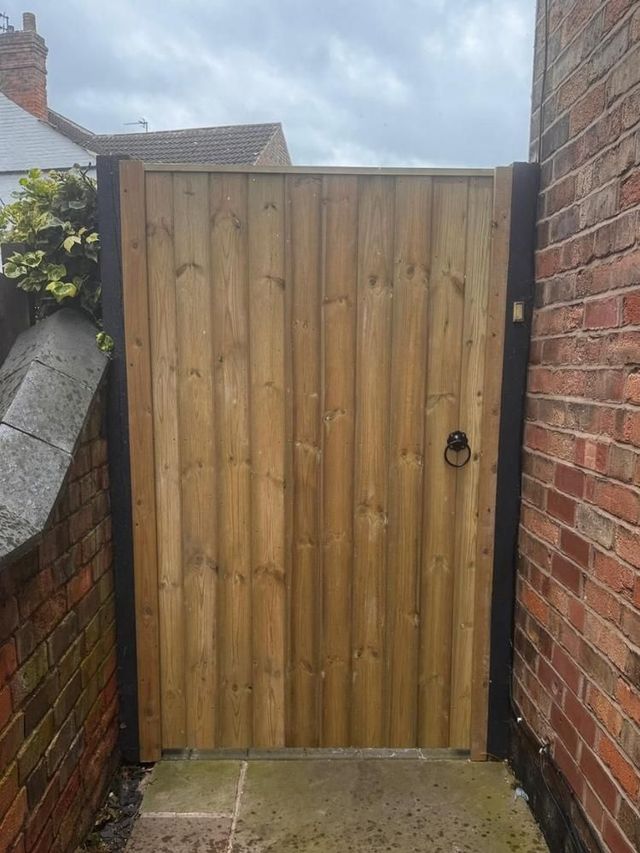
Hung between two walls
No ground to dig into on either side, so the frame is fixed back to the masonry and the gate hangs off that. Tight passages like this are the most common side gate job there is.
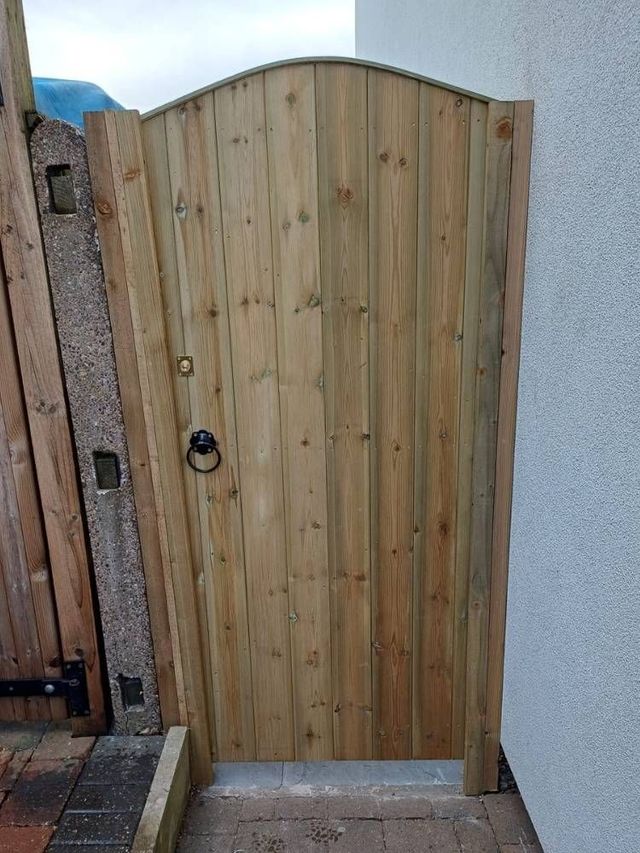
Arched tongue and groove
A tall gate in a narrow gap can look like a mistake. The arch gives the height a reason to be there, and the tongue and groove boards keep the face solid with no gap to see through.
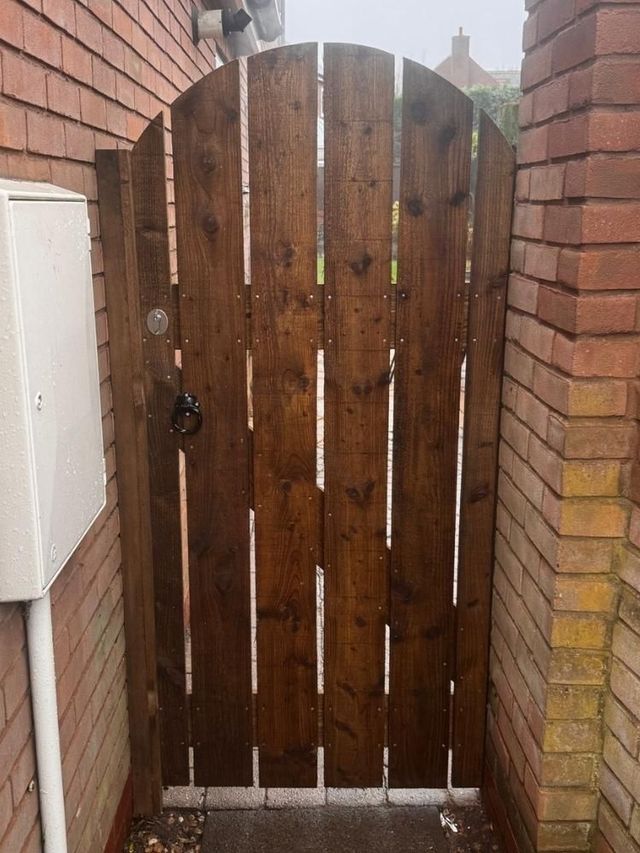
Bespoke, with spaced boards
Made to the opening rather than cut down from a stock size, and the boards are set with gaps on purpose — a solid gate in a passage this narrow turns it into a tunnel. Dark stain rather than the usual treated green.
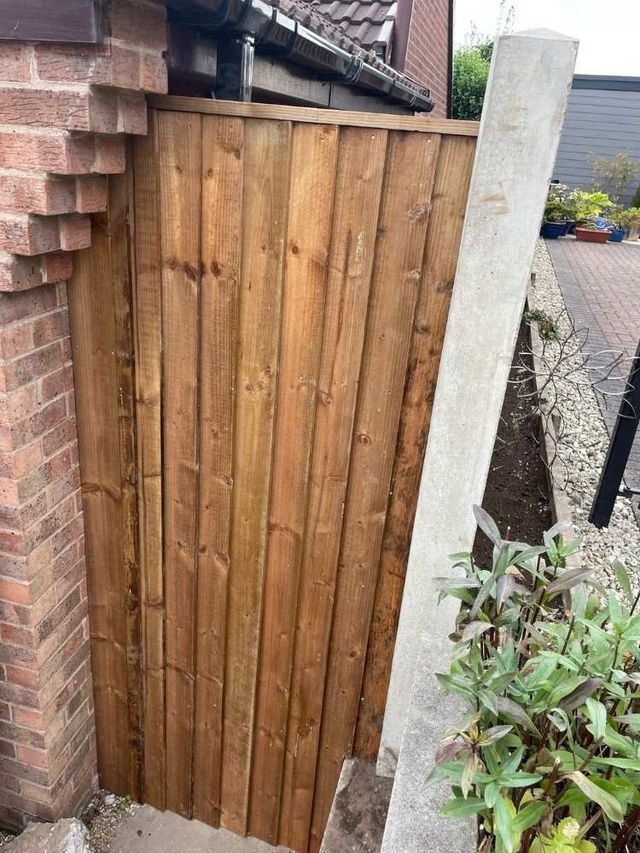
Featheredge, matching the fence
Built in the same featheredge as the run it sits in, so the boundary reads as one thing. A gate in a different board profile is the first thing the eye finds.
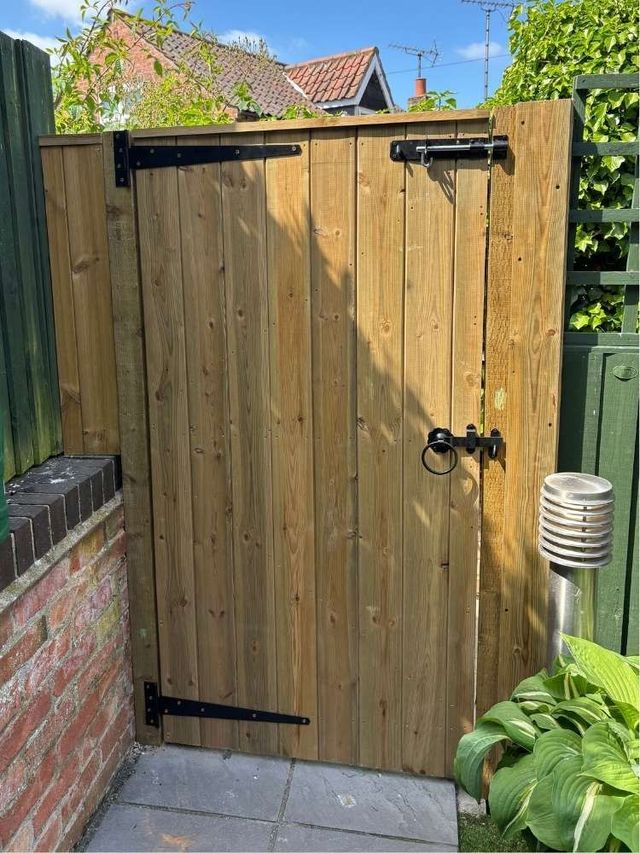
Long straps, bolt and lock
Strap hinges running most of the way across the gate rather than short hinges at the edge. On a gate used every day the length of the strap is what stops the drop, because it spreads the load across the boards instead of into one stile.
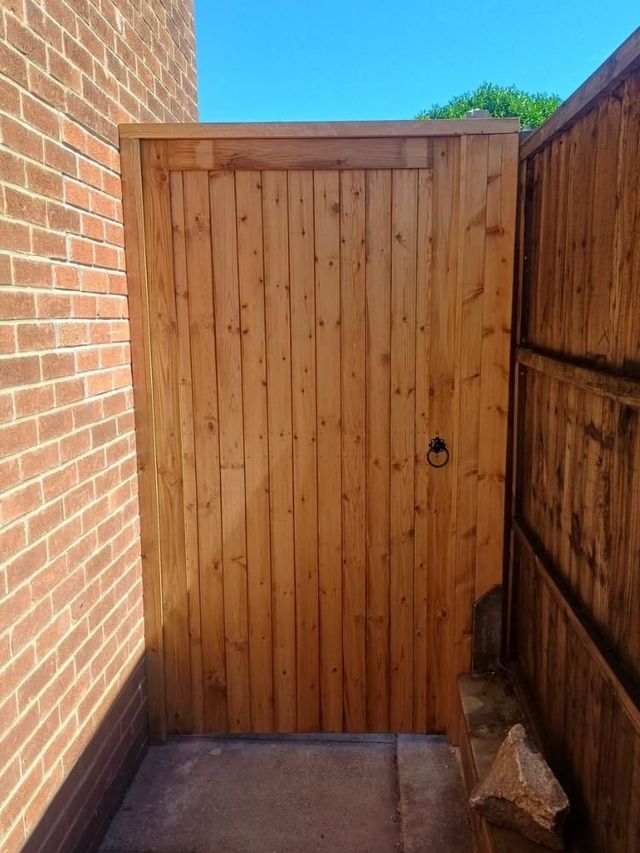
Framed and capped
A capping rail across the top covers the end grain of every board. Timber drinks through its end grain first, so a capped top is the difference between a gate that greys evenly and one that rots from the top down.
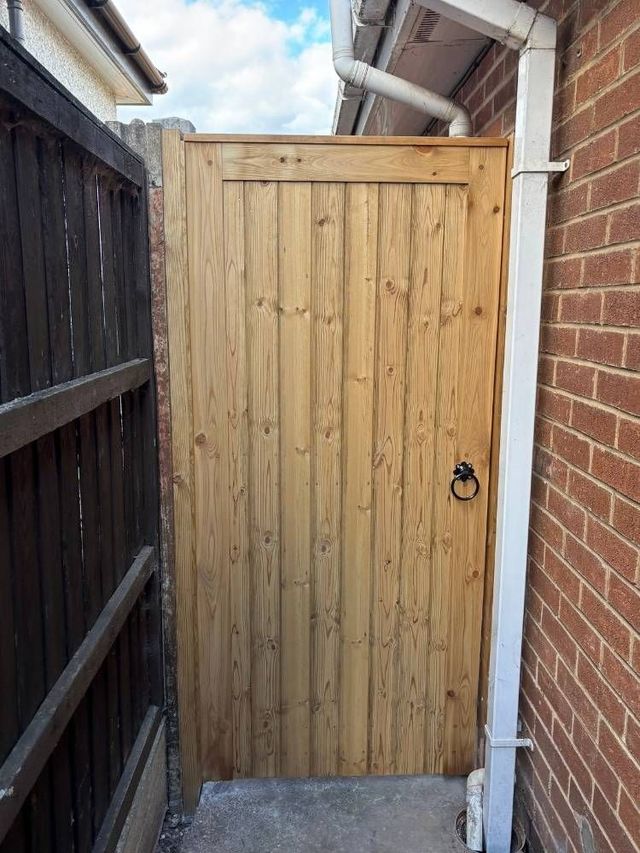
Into an existing gap
Hung between a fence that was already there and the house wall, with the gate post scribed in against the brick. The old panel stays; only the opening changes.
Timber Decking
Decking is a frame job with boards on top. Almost every deck here sits on ground that was never level — an old patio, a slope, a courtyard with no access — and the height is decided by the door it steps out of rather than by the ground it stands on. The first three photographs are one job, from bare frame to finished.
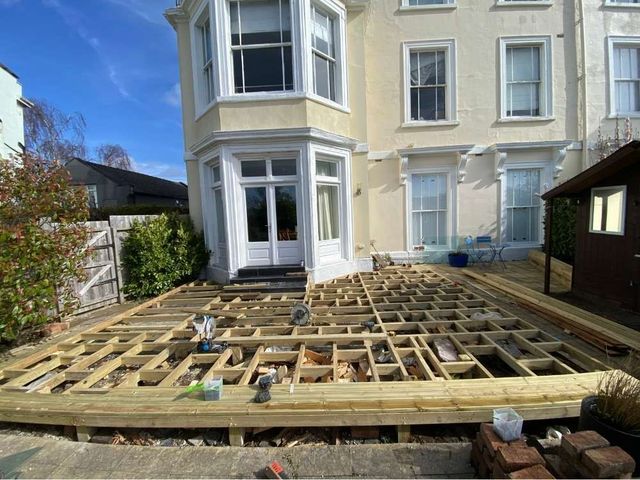
The frame doing the work
This is the part nobody photographs and the only part that matters. The joists carry the whole deck; the boards on top are a wearing surface. Deck height is set by the door threshold, not by the ground, so the frame is packed and levelled to land flush with the step. How a deck is built up from the ground is set out on the decking in Nottingham page.
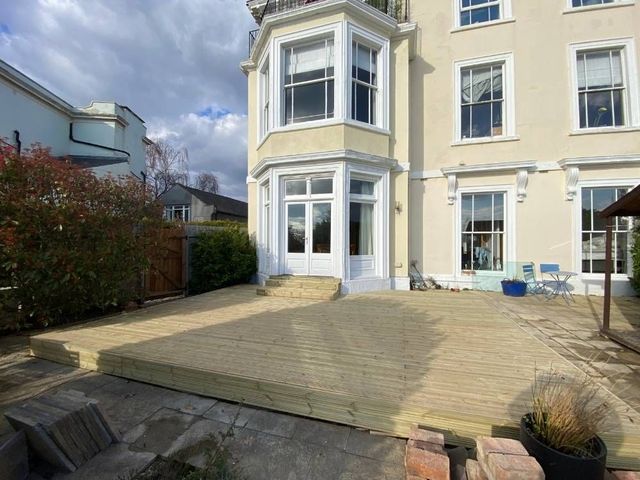
The same deck, finished
The same job with the boards down, running across the full width of the elevation and stepping up to the doors. The old flagged patio is still underneath it — nothing was dug out.
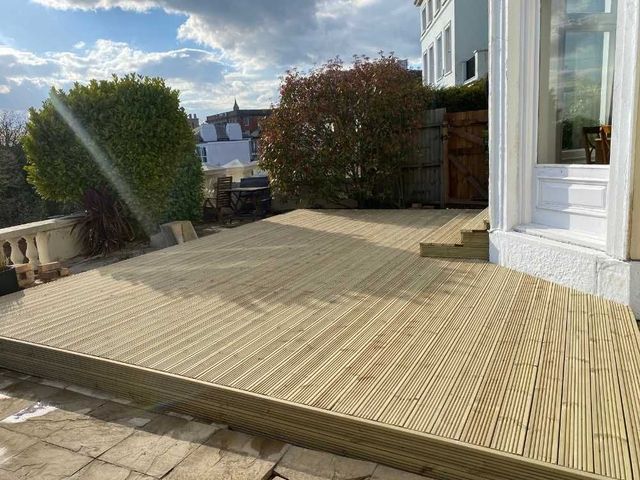
Side on, at the edge
Worth seeing the edge. The fascia closes the frame off so the joist ends are covered, and the deck finishes against the original flagstones rather than butting into them.
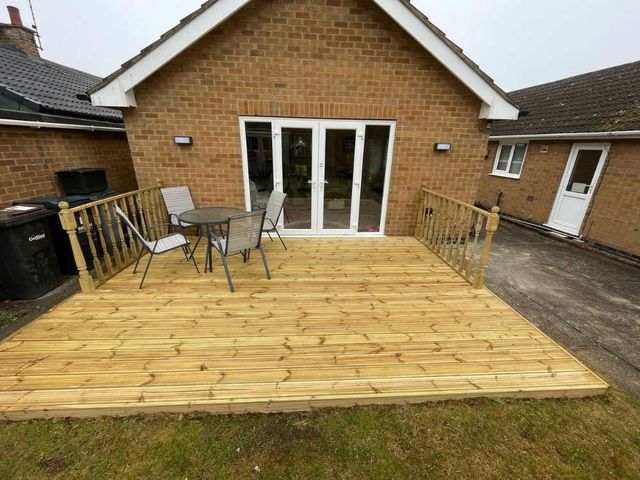
Balustrade both sides
Level with the threshold, so there is no step out of the doors at all. Balustrades on the two sides where the deck meets a drop, left open at the front where it steps down to the lawn.
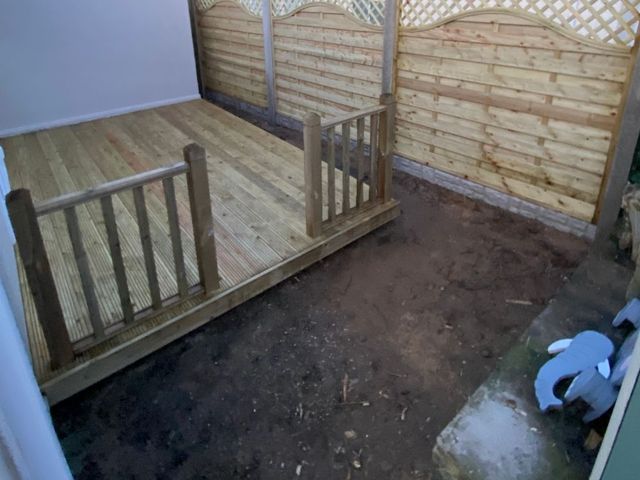
Raised, with new fencing behind
Raised to meet the door, which is when a balustrade stops being a style choice. As a general rule a raised platform more than 300mm above ground can need planning permission, and guarding is expected once there is a drop to fall down. We are not building control — worth a call to the council on anything raised.
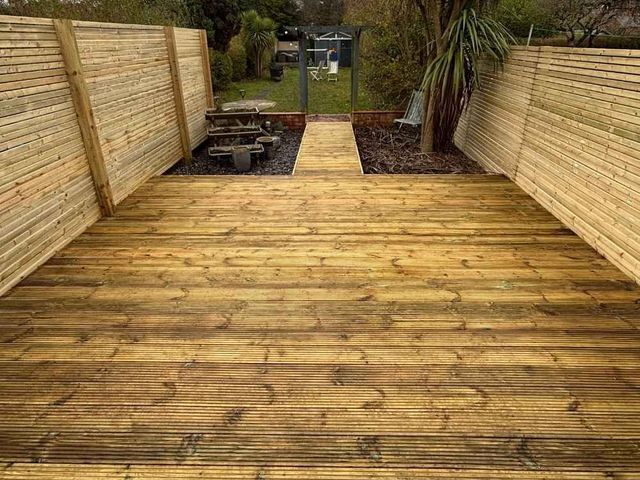
West Bridgford — from the house
A full width deck across the back of the house with new slatted fencing either side, and a decked walkway carrying on down the middle of the garden to the lawn. This one is on the decking in West Bridgford page.
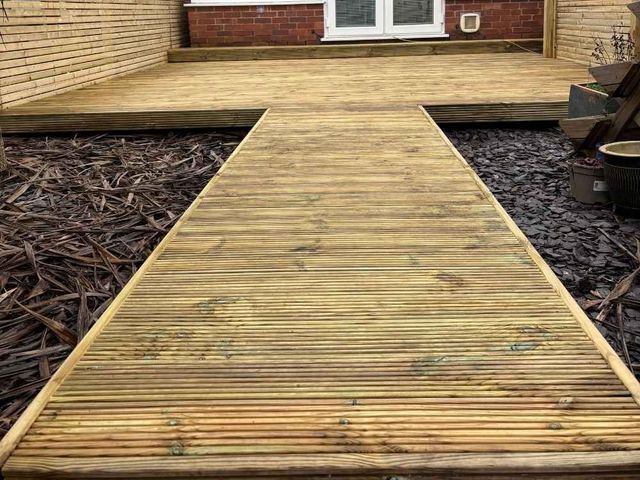
The same deck — from the garden
Looking back the other way. The walkway is the same board in the same direction as the deck it runs off, which is what stops it reading as a path bolted onto a deck.
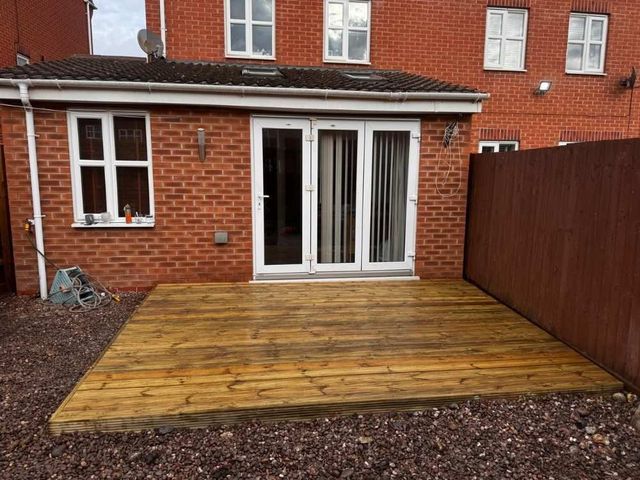
A landing, not a patio
Not every deck needs to fill the garden. This one gives somewhere level to step out onto from the bi-folds and stops at that, with the gravel left as it was either side.
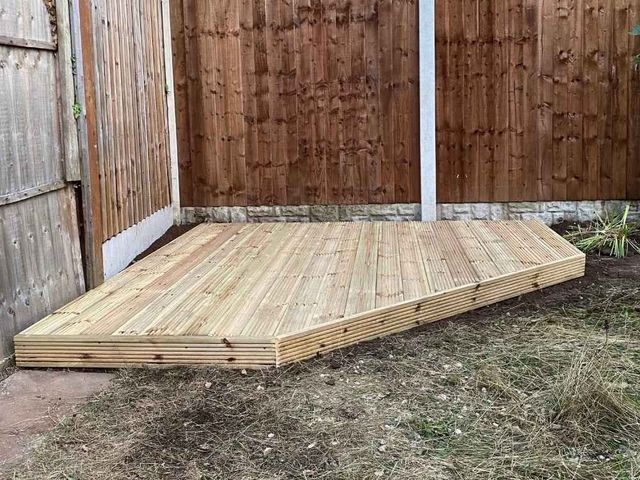
Cut into a corner
Built into the corner where two boundaries meet, with the front edge cut off at an angle rather than left as a square that nobody can walk round. Usually the base for a seat, a bin store or a shed.
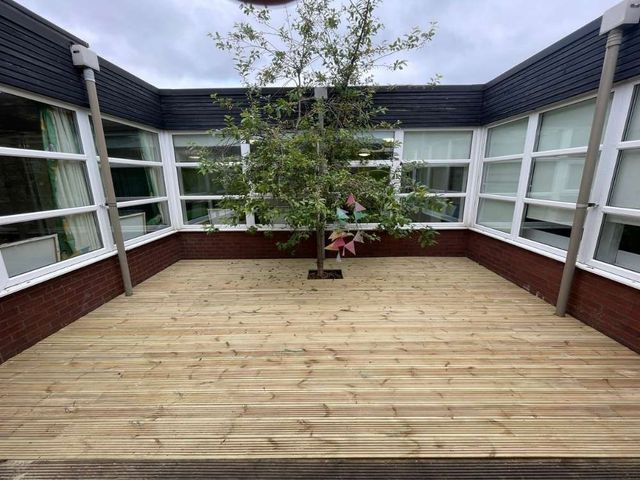
A school courtyard
An enclosed courtyard with no vehicle access, so everything came through the building. The deck is laid around the tree that was already there, with a gap left round the trunk so it still has room.