
Fencing Annesley
Timber, composite and metal fencing, gates and railings across Annesley, Annesley Woodhouse and Newstead. Composite fencing and composite gates , closeboard and featheredge panels on concrete posts, and made-to-measure driveway gates. Send your measurements and a photo for a quick provisional price, or book a free measured survey.
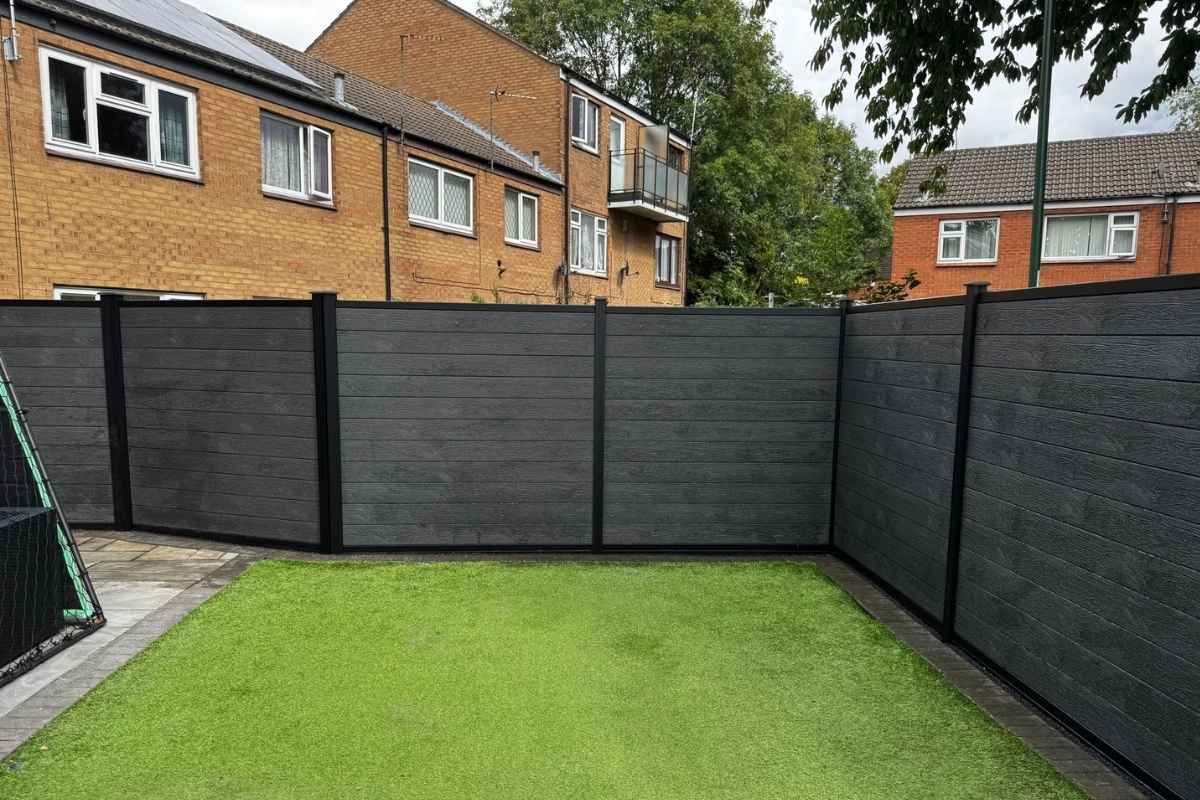
*Terms and conditions apply to our 12 month guarantee.
The Kind of Work We Do
From a standard rear boundary to a made-to-measure pair of driveway gates. Here is a cross-section of the fencing and gate work we take on across Nottinghamshire and the Ashfield towns.
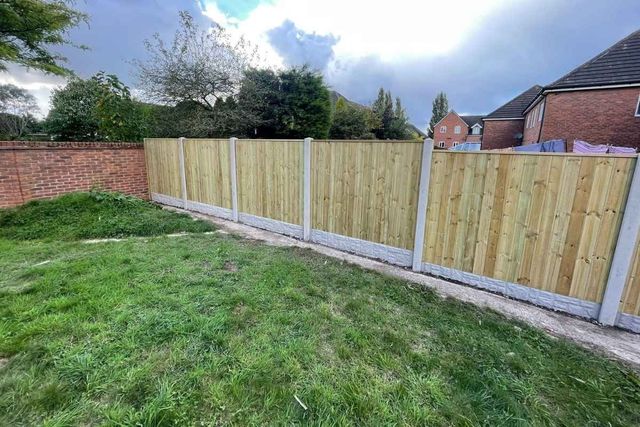
Featheredge on concrete posts
The workhorse boundary: featheredge panels slotted into concrete posts with rock-faced gravel boards at the base. Concrete does not rot where timber posts always do, and a single damaged panel lifts out without disturbing anything either side. See fence panels.
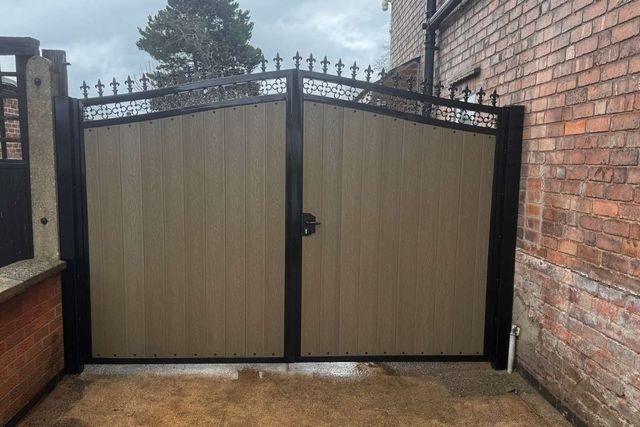
Composite driveway gates
Natural-toned composite boards in a black metal frame, with a scrollwork top and fleur-de-lis finials. The metal frame is what keeps a pair of gates meeting properly in the middle years later — timber frames rack, and that is when gates start dropping. See composite gates.
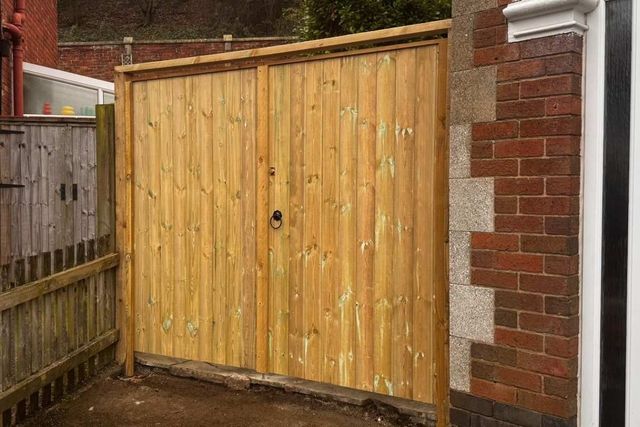
Tongue and groove double gates
Solid timber double gates built to the opening between a brick pier and the house. Tongue and groove gives a flat face with no gaps to see through, and the ledged and braced frame behind is what stops it sagging on the latch side. See garden and side gates.
Fencing and Gates in Annesley
Annesley and Annesley Woodhouse sit at the top of Ashfield District, either side of the A611 and close to junction 27. The housing splits fairly cleanly: older colliery-era terraces and semis in the Woodhouse, and a good deal of newer estate building on the Annesley side, some of it recent enough that the original developer fencing is only now reaching the end of its life.
That second group produces a particular kind of enquiry. Developer boundaries all go in at the same time, in the same materials, to the same budget — so they also fail at roughly the same time. It is why several neighbours on the same street tend to get quotes in the same summer, and why the first question is usually not what fence, but whose fence.
Whose Boundary Is It?
There is no general rule that you own the left-hand fence, or the right-hand one. That is a myth and it causes a lot of unnecessary argument.
What normally decides it is the title plan for your property, held by HM Land Registry. Plans frequently carry a T-mark against a boundary: a small T drawn on one side of the line. By convention, the side the T sits on is the property responsible for maintaining that boundary. An H-mark, effectively two Ts back to back, indicates a shared responsibility.
Two honest caveats. The T-mark is a conveyancing convention rather than a law, and it only carries weight where the transfer or deed actually refers to it. Plenty of older titles have no marks at all, in which case responsibility comes down to what the deeds say, what has happened historically, or simple agreement between neighbours.
We are not solicitors and we cannot tell you who owns a boundary. What we can do is fit a fence on the line you and your neighbour agree. If it is genuinely unclear, a copy of your title plan from HM Land Registry costs a few pounds and settles most cases before anyone spends money on timber.
Worth doing before you order
Talk to the neighbour first. Not for permission — you do not need it on your own boundary — but because a replacement fence usually needs access from both sides to fit properly, and a conversation beforehand is easier than a conversation halfway through.
Check for a covenant. Newer estates often carry restrictions in the transfer about front boundary treatments, heights or materials. These bind you regardless of what permitted development allows, and they are in your deeds rather than at the council.
Agree who pays. Where a boundary is shared, cost is a matter of agreement, not entitlement. Neither neighbour can be compelled to contribute.
What We Install in Annesley
Replacing Developer Fencing
Estate fencing is generally built to a price. Thin posts, lap panels, and often no gravel board at all, so the bottom of the panel sits against soil from day one. It usually gives eight to twelve years depending on exposure, and it goes at the posts first.
When it is replaced there are two sensible routes. Closeboard or featheredge on concrete posts with gravel boards is the cost-effective one and will comfortably outlast what came out. Composite costs more up front and nothing afterwards — no staining, no treating, colour running through the board rather than sitting on it.
Where the existing concrete posts are sound, composite panels will normally slot straight into them, which keeps both the cost and the disruption down. Whether that applies to your run is a survey question, because it depends on the condition of the posts rather than the age of the fence.
Getting Rid of the Old Fence
Annesley is Ashfield District Council. The brown bin is not an option: garden waste is a subscription service that runs March to December, and the council explicitly excludes timber and DIY waste, checks bins and will not empty one containing them.
The tips belong to Nottinghamshire County Council and cap DIY waste at two 50-litre bags or one item per visit, with four visits per household every four weeks — a 6ft panel exceeds the single-item size limit on its own. And where the work was done by a tradesperson, the county council states that disposal is legally that tradesperson's responsibility.
We remove and dispose of the old fence as part of the job, under waste carrier licence CBDU474286. If you would rather keep the timber, we will price the work without removal.
Fence Heights and Permission
Permitted development in England generally allows 2 metres at a rear or side boundary and 1 metre where the boundary fronts a highway, footpaths beside roads included. Gravel boards and trellis both count towards the finished height.
On newer estates, check the transfer for covenants before you rely on that — a covenant restricting front boundary treatments will bind you even where planning rules would not. Ashfield District Council's planning team will confirm the planning position free of charge; the covenant question is one for your deeds.
Why Choose Nottingham Fencing
We are a local, family-run firm run by founders Adam and Stephen, with over 15 years' experience fitting fencing across Nottinghamshire.
- We fit on the line you agree. We will not adjudicate a boundary dispute, but we will work to whatever you and your neighbour settle on, and we will tell you plainly if something looks unclear before we start.
- Sound posts stay. If your existing concrete posts are good, composite or timber panels go straight back into them. Less cost, less disruption, nothing dug out.
- The old fence goes with us. Registered waste carrier, licence CBDU474286.
- Gates built to the opening. Timber, metal-framed composite or wrought iron style, made to measure rather than trimmed from stock.
- Supply only if you want it. Panels, posts, gravel boards and composite sold on their own.
- Insured and guaranteed. Public liability insurance in place and a 12 month guarantee on our work.*
*Terms and conditions apply to our 12 month guarantee.
Areas We Cover Near Annesley
We cover Annesley, Annesley Woodhouse and the surrounding area:
Get a price for your Annesley fence
Send your measurements and a photo for a quick provisional price, or book a free measured survey and we will come and look at the run properly.
Fencing in Annesley — Common Questions
Is it true I own the fence on the left?
No. There is no general rule about left or right, and it causes a lot of unnecessary argument. Responsibility is normally set out in your title plan and deeds. We are not solicitors and cannot tell you who owns a boundary, but we will fit a fence on whatever line you and your neighbour agree.
What is a T-mark on my title plan?
A small T drawn against a boundary line on the plan. By conveyancing convention, the side the T sits on is the property responsible for maintaining that boundary, and an H-mark, effectively two Ts back to back, indicates shared responsibility. It is a convention rather than a law and only carries weight where the deed refers to it. A copy of your title plan from HM Land Registry costs a few pounds.
Do I need my neighbour's permission to replace a fence?
Not on a boundary that is your responsibility. It is still worth talking to them first, because replacing a fence usually needs access from both sides to fit it properly, and that conversation is much easier before the job than halfway through it.
Can my neighbour be made to pay half?
No. Where a boundary is shared, splitting the cost is a matter of agreement rather than entitlement, and neither neighbour can be compelled to contribute. If you are paying for it yourself, the decision on materials and height is yours, subject to the usual planning limits and any covenant in your deeds.
How long does developer estate fencing last?
Usually eight to twelve years depending on exposure. It tends to be built to a price, with thin posts, lap panels and often no gravel board, so the bottom of the panel sits against soil from the start. It generally fails at the posts first, which is why whole streets end up replacing at around the same time.
Can composite panels go into my existing concrete posts?
Usually yes, if the posts are sound and plumb. Composite boards slot into the same channels the old panels came out of, so nothing is dug out and the planting and paving either side are left alone. Whether it applies to your run depends on the condition of the posts rather than the age of the fence, which is what the survey checks.
Do covenants on a new estate affect my fence?
They can. Newer developments often include restrictions in the transfer covering front boundary treatments, heights or materials, and those bind you regardless of what permitted development would otherwise allow. They sit in your deeds rather than with the council, so they are worth checking before you order anything.
Do you supply fencing in Annesley without fitting it?
Yes. Supply only is available on closeboard, featheredge and lap panels, concrete and timber posts, gravel boards, trellis and composite boards. Measure your post centres rather than the visible gap, tell us the run length and height, and we will price the materials for collection or delivery.